
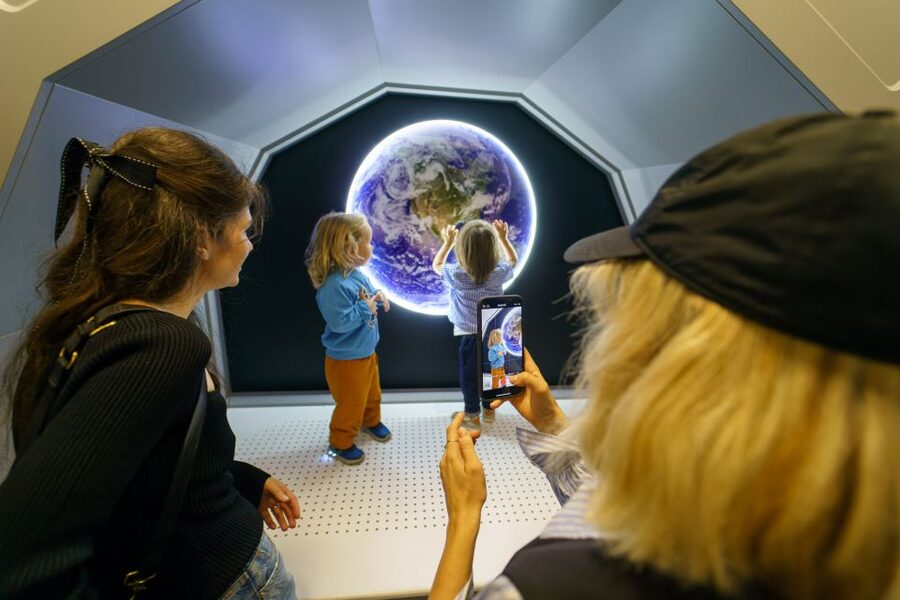
Reviewed · BUCHAREST MUSEUM TICKETS
Bucharest: Museum of Senses Entry Ticket
The Museum of Senses turns a simple hour indoors into a playful test of what your eyes, ears, and brain think they know. You’ll work through 40 exhibits in 11 rooms, including Bucharest’s biggest mirror maze, an RGB room, an infinite tunnel, and optical illusions that make ordinary spaces behave badly.
I like the way the staff help you use the exhibits rather than simply point you through them. Calin is singled out for guiding visitors around, while other staff members regularly offer to take photos and videos. I also like the easygoing photo policy, free lockers, and the fact that the museum works well for a quick family outing or a rainy afternoon.
The main drawback is size. You can see the whole museum in about an hour, and some adults may find a few displays more amusing than substantial. Since it sits on the top floor of a shopping center, finding the entrance can take a little patience.
Key points to know before you go
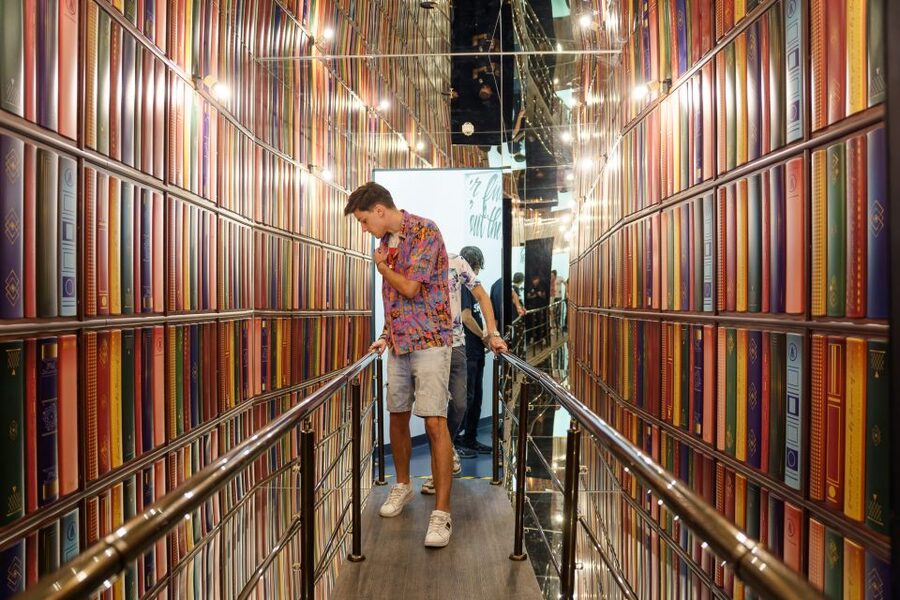
- Forty exhibits fill eleven rooms: Expect a compact route with frequent changes in light, sound, mirrors, and visual perspective.
- The mirror maze is the opening challenge: Finding the exit is a fun way to start, but watch your pace and follow the room’s guidance.
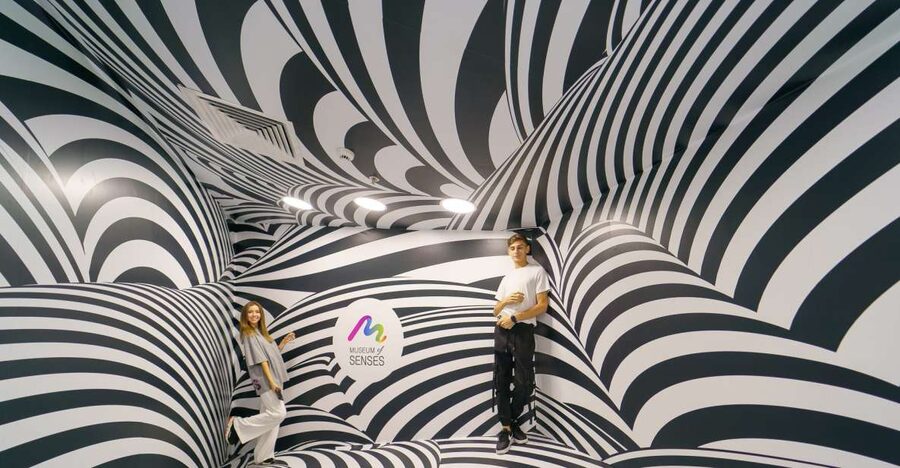
- The Ames room and vortex tunnel twist perception: These are among the best stops for photos and for understanding how the brain misreads space.
- Staff are part of the experience: Calin and other team members may explain rooms, point out missed exhibits, and take photos for you.
- Plan on about one hour: The museum offers good short-visit value, but it is not a half-day attraction.
- It is inside a shopping center: Look for the museum on the top floor, not as a separate street-level building.
Entering Bucharest’s Museum of Senses
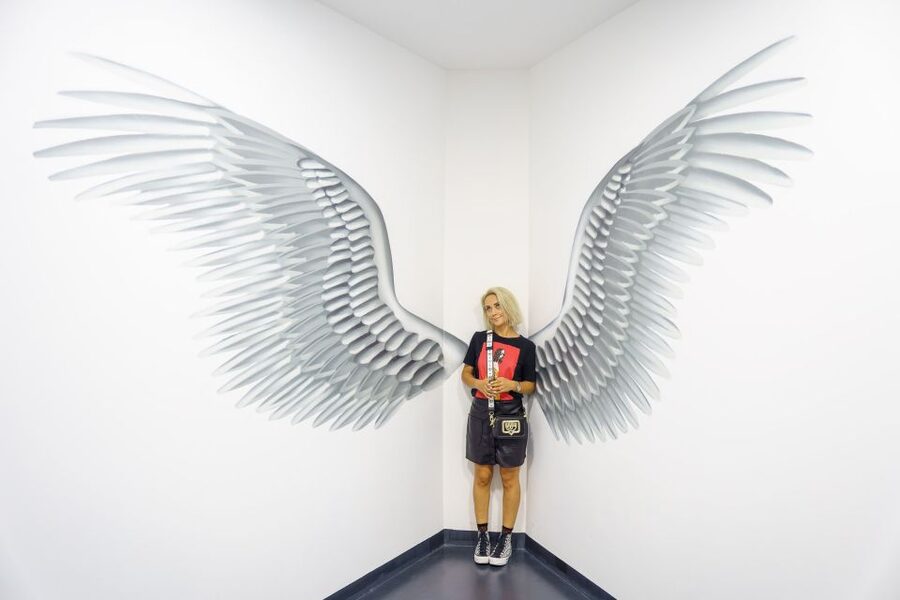
The Museum of Senses is built around a clear idea: your senses can be fooled with surprisingly simple tools. Mirrors, colored light, forced perspective, sound, and altered rooms make your brain fill in gaps that are not really there.
You exchange your ticket at the entrance, receive a few basic guidelines, and then move through the rooms at your own pace. The setting is friendly and hands-on. This is not a quiet museum where you keep your distance from the displays. You are expected to try things, pose for pictures, and test your reactions.
The museum is in a shopping center on the top floor. That detail matters because the location can be harder to spot than the attraction itself. Give yourself a few extra minutes to find the correct level, especially if you are meeting friends or arriving close to your timed entry.
The visit lasts about one hour. That makes it easy to fit between shopping, lunch, or other Bucharest plans. It also means you should set your expectations correctly: this is a compact interactive attraction, not a large science museum with long explanations and many galleries.
More museums and tickets in Bucharest:
- Communism in Bucharest – Landmarks, Museum & Communist Appetizers
★ 5.0 · 111 reviews - Bucharest: Entry ticket at the Museum of Communism
★ 4.6 · 57 reviews - Bucharest: Museum of Communism Ticket with Communist Coffee
★ 4.6 · 52 reviews
Finding your way through the biggest mirror maze in Bucharest
The mirror maze is the first major challenge. It gives the visit a clear starting point and immediately asks you to question what you see. Reflections multiply the route, corners become hard to judge, and the obvious way forward may not be the correct one.
I like this room because it is active without being complicated. You do not need specialist knowledge or a long attention span. You simply move carefully, look for the exit, and enjoy the confusion. It also creates good group entertainment because one person’s confident route can quickly turn into a dead end.
Take your time here. The maze is more enjoyable when you stop, check your surroundings, and avoid rushing into a mirror. If you are visiting with children, stay close enough to keep the group together. The museum provides guidance, but the appeal comes from working things out yourself.
The mirror maze is also one of the better reasons to visit with friends or family. You can compare how each person reacts to the same visual trick. Solo visitors can still enjoy it, and the staff may help with photos, but the social side adds a lot.
Colored light, the infinite tunnel, and the fear of height
The RGB room uses red, green, and blue light to change the feel of the space. It is a simple concept, but the shifting color gives you a new way to look at people, walls, and photographs. This is a good room for pictures because the lighting does much of the work.
Next comes the infinite tunnel, designed to test your sense of height and distance. The point is not a real drop. The room uses visual effects to make your body feel less certain about where the floor and walls end.
If you dislike heights, this may be the room that asks the most of you. You can approach it at your own pace, and the effect is part of the fun, but it may not feel relaxing. I would not rush a child or anyone who is uneasy with the illusion. The museum is at its best when you treat each display as an invitation rather than a test you must pass.
These rooms show the museum’s main strength. It takes familiar ideas, colored light and reflections, then gives you a physical way to understand how quickly your senses can be led astray.
Optical illusions in the 2D café and desert rooms
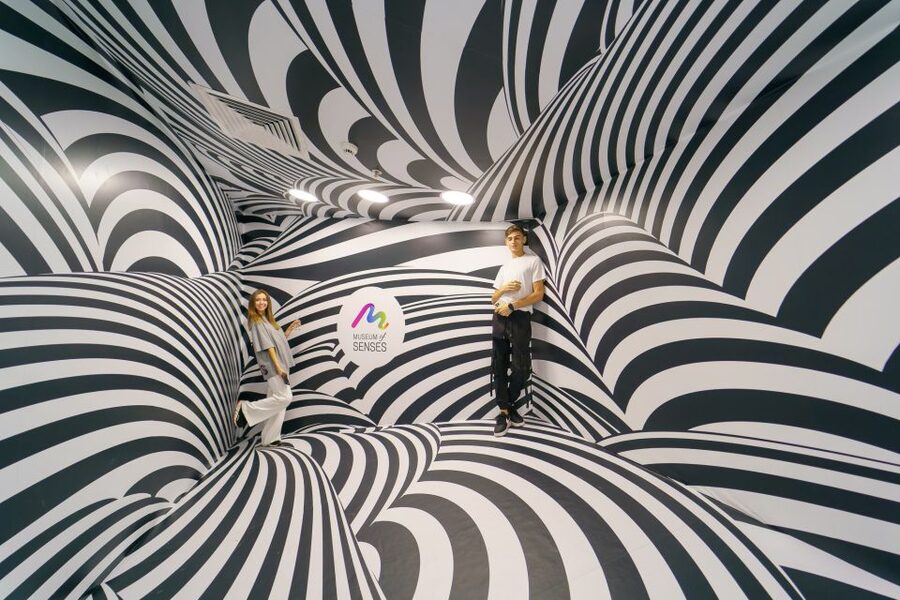
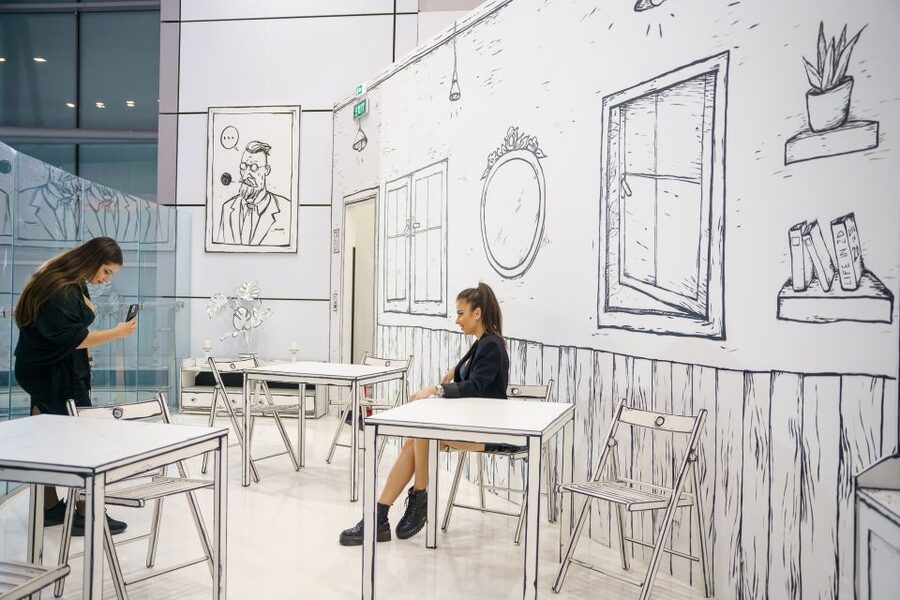
The optical illusion section shifts from movement to close observation. You may find spaces designed to look flat, oversized, or otherwise out of proportion. The 2D café room is a strong example. It plays with the visual language of a café while making the setting feel more like a drawing than a normal room.
The desert-themed section adds another change of mood. Rather than offering a natural-history lesson, it uses the desert as a setting for mind-bending visual effects. The value here is photographic and playful. You can place yourself inside the illusion and see how much the camera changes the result.
This is where the staff can be especially useful. The rooms make more sense when you know where to stand, and a team member can help you find the right angle. Staff members have also been known to point out rooms people miss and take photos for solo visitors or groups.
Do not judge every display by the same standard. Some illusions are impressive right away. Others are quieter and depend on the angle, the lighting, or the photograph. The variety keeps the route moving, even though the museum itself is fairly small.
Same city, a completely different sort of day:
- Bucharest: Dracula’s Castle, Peles Castle, & Brasov Old Town
★ 4.5 · 17,858 reviews - Bucharest: Dracula Castle, Peles Castle & Brasov Old Town
★ 4.6 · 10,891 reviews - Bucharest: Dracula’s Castle, Peleș Castle & Brașov Day Trip
★ 4.5 · 5,919 reviews - Bucharest: Palace of Parliament Tickets and Guide
★ 4.3 · 3,182 reviews
The Ames room and the science of a distorted view
The Ames room is one of the most familiar perception exhibits, and it earns its place here. The room is built so that people standing in different areas appear to be very different sizes. Your eyes report one thing, while your understanding of normal room shapes tells you something else.
This is a useful stop because it explains the museum’s purpose better than a sign alone could. Your brain expects walls, floors, and corners to follow certain rules. When the room breaks those rules, your brain still tries to make a sensible picture.
The effect works best when two people stand in the room at once. It gives you an immediate comparison, and the change in apparent scale is easy to see in a photograph. Ask a staff member for help if you are unsure where to stand. The right position makes a big difference.
For adults, this kind of exhibit can be more satisfying than a display that only produces a quick visual shock. It gives you a small lesson in perception without turning the visit into a classroom. For children, it is simply strange and funny, which is often enough.
The vortex tunnel and infinity mirror room
The vortex tunnel creates the feeling that the room is moving or spinning, even though the structure around you remains fixed. It is another good reminder that balance depends on what your eyes tell your body. Move slowly if you feel unsteady, and give yourself a moment before heading to the next room.
The infinity mirror room offers a different kind of visual effect. Mirrors repeat lights and reflections until the room appears to stretch far beyond its actual walls. It is one of the best spots for a photo, especially if you use the room’s lighting and take a little care with your position.
You can also dance to the music in the infinity mirror room. That detail keeps the display from feeling like a static photo booth. It becomes a small performance space, though the experience remains brief and compact.
The vortex tunnel and infinity room are close in spirit, but they affect you in different ways. One challenges balance and movement. The other creates depth, repetition, and atmosphere. Together, they give the middle of the visit a welcome change from the maze and still-image illusions.
Photos, lockers, and helpful staff
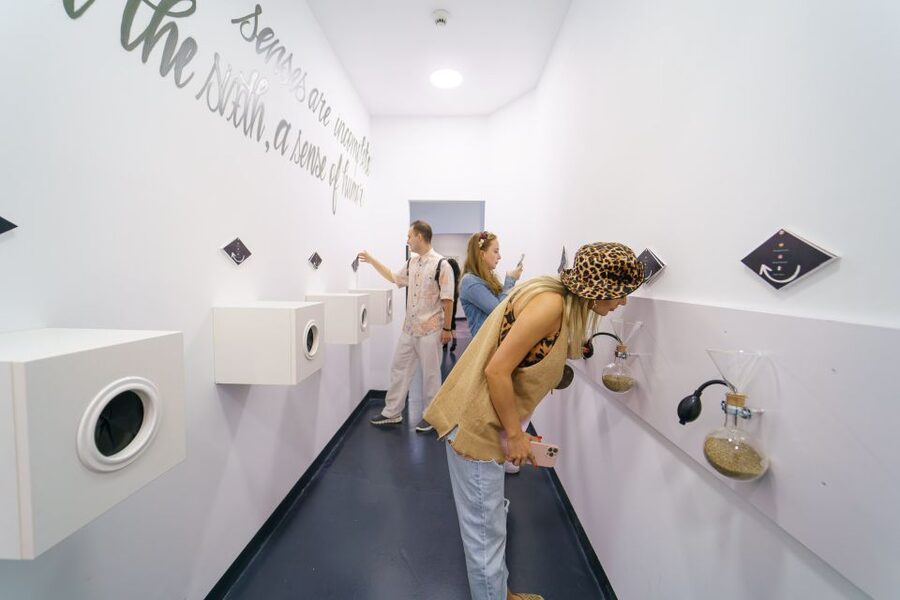
The Museum of Senses encourages you to take as many photos as you like and broadcast live video to family and friends. That policy is important here because photos are not an afterthought. Many exhibits are designed to make more sense once you see the image afterward.
Free Wi-Fi helps with sharing, while the cloakroom and lockers let you put away bags and jackets. Free lockers are a small but useful touch in a space where you need to move around and look closely at the displays.
The staff receive some of the strongest praise for the experience. Calin is mentioned as a particularly helpful team member who guides visitors through the attractions. Other staff members offer to take pictures and videos, explain the rooms, and help you find displays you may have walked past.
That service makes a real difference for solo visitors. You do not need to skip the best photo rooms simply because you have no one to hold the camera. For families and groups, it also keeps the visit moving and helps everyone get a turn in the displays.
Who gets the best value from the one-hour visit
At $10 per person, or about 50 Romanian lei according to one price comparison, the museum offers fair value if you want a short, active attraction. The cost works best when you use the rooms fully, take photos, and treat the staff guidance as part of the visit.
I would recommend it most strongly for families with children, groups of friends, couples who enjoy playful photos, and anyone looking for something different from standard sightseeing. The displays are easy to understand, require no language-heavy explanation, and give children a chance to move around.
Adults who enjoy optical illusions will likely have a good time, though expectations matter. Some rooms are genuinely clever, while others are simple and quick. If you have visited several similar sensory attractions, the museum may feel smaller and less varied than expected.
The one-hour length is both a strength and a limitation. It is a good choice when you have a spare afternoon or want a break from outdoor sightseeing. It is not the right pick if you want a major attraction that occupies several hours.
Most of the exhibits are wheelchair accessible, but a few have a step and cannot be used in the same way. If accessibility is important for your visit, check the route with staff at the entrance. The activity is listed as wheelchair accessible, but that does not mean every single display has step-free access.
Practical details that shape the visit
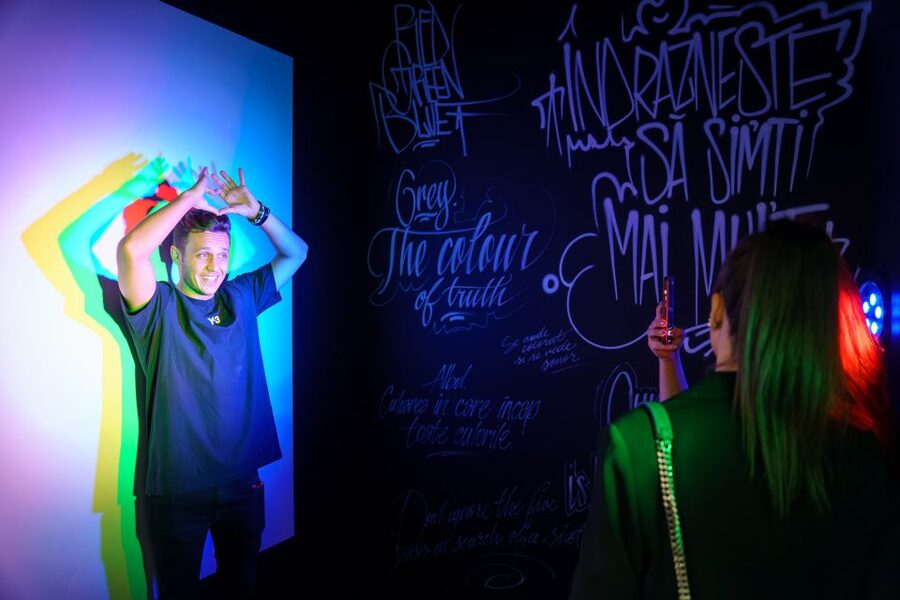
You can cancel up to 24 hours before the activity for a full refund, and the reserve-now, pay-later option lets you hold a place without paying immediately. Check the available start times before booking because the activity runs in timed slots.
The attraction is operated by 6S Entertainment Romania SRL. The entry ticket includes admission, Wi-Fi, and use of the cloakroom and lockers. You do not need to budget separately for those services.
The location inside a shopping center is useful once you find it. You can combine the visit with shopping or a meal, and the surrounding center gives you a practical place to continue your day. Just remember the top-floor location when planning your arrival.
Allow roughly one hour inside. You may finish sooner if you move quickly, or take longer if you stop for photos and repeat favorite rooms. The museum is quiet at times, which makes it easier to move through the rooms and take pictures without feeling hurried.
Should you book the Museum of Senses?
Book it if you want a light, playful hour with strong photo opportunities, helpful staff, and a good mix of mirrors, lights, tunnels, and optical illusions. It is particularly easy to recommend for children, families, and friends who enjoy trying odd displays together.
Think twice if you expect a large museum, detailed science exhibits, or a full half-day outing. The experience is compact, and several rooms are quick to understand. At $10, it is reasonable for a short indoor activity, but its value depends on enjoying interaction more than extensive content.
For most Bucharest itineraries, I would treat the Museum of Senses as a convenient add-on rather than the main event. Pair it with time at the shopping center, use the free lockers, ask staff such as Calin for help with photos, and give yourself enough time to find the top-floor entrance.
FAQ
How long does the Museum of Senses visit last?
The activity lasts about one hour. You can spend more or less time inside depending on how long you take with photos and exhibits.
How many exhibits are at the Museum of Senses?
The museum has more than 40 exhibits spread across 11 rooms.
What are the main exhibits?
You can find a large mirror maze, an RGB room, an infinite tunnel, a 2D café room, a vortex tunnel, an Ames room, and an infinity mirror room.
Can I take photos inside the museum?
Yes. The museum encourages visitors to take photos and broadcast live videos to family and friends.
Are lockers available?
Yes. Cloakroom service and lockers are included with admission, and the lockers are free of charge.
Is the museum wheelchair accessible?
The activity is listed as wheelchair accessible, and most exhibits can be reached by wheelchair. A few displays have a step and are not accessible in the same way.
Where is the Museum of Senses located?
It is located in Bucharest-Ilfov, inside a shopping center on the top floor. The top-floor location is useful to know because finding the entrance can be difficult.
Can I cancel the booking?
Yes. You can cancel up to 24 hours in advance for a full refund. A reserve-now, pay-later option is also available.
Newest Bucharest trips we have written up
- Bucharest: Dealu Mare Winery Private Trip with Wine Tasting★ 4.9 · 6 reviews
- Winery touring & private wine tasting – one day private tour★ 5.0 · 3 reviews
- Traditions in Bucharest: Village Museum and Wine Tasting★ 5.0 · 8 reviews
- Your rendez-vous with Europe’s past: time-travel to Maramures, Transylvania★ 5.0 · 6 reviews
- Village Museum Bucharest Guided Tour★ 5.0 · 6 reviews
- Private Wine Tasting at Bucharest’s First Wine Bar★ 5.0 · 3 reviews
- Walking Tour of Bucharest City Center – Private Tour★ 5.0 · 4 reviews
- Wine tasting in Bucharest Old town – bonus cheese platter★ 4.5 · 6 reviews
Bucharest Museum Tickets, compared.
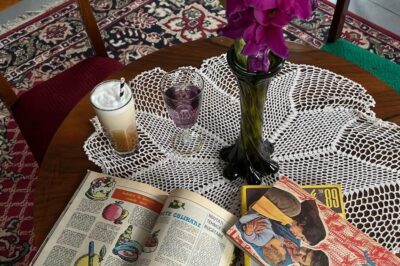

Museum of Communism Ticket with Communist Coffee
Read our review →
Dinner+Tour at Museum of Communism after closing
Read our review →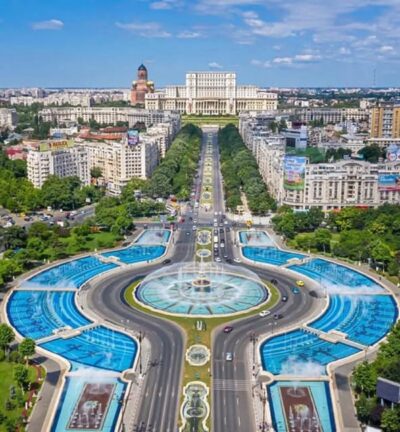
Palace of the Parliament, Village Museum & Ceaușescu Mansion
Read our review →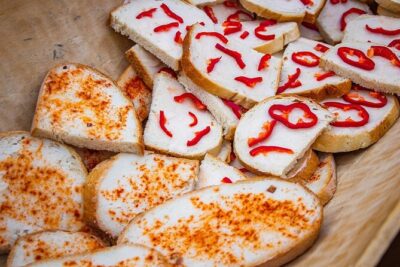
Dinner at the Museum of Communism & tour after closing
Read our review →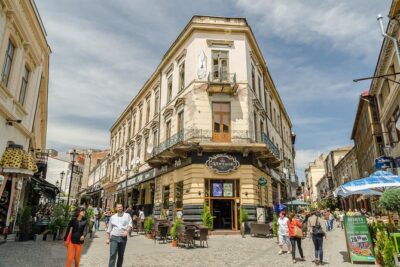
Private Bucharest city tour visit the Palace of the Parliament & Village Museum
Read our review →
Traditions in Bucharest: Village Museum and Wine Tasting
Read our review →
National Village Museum and Salt Mine in a Day Tour
Read our review →Browse the lists this tour appears in