
Reviewed · BUCHAREST COMMUNISM AND CEAUSESCU TOURS
Bucharest Under Communism: Life, Terror & Hope
Bucharest’s communist past is easiest to grasp on foot, where grand boulevards, hidden churches, empty viewpoints, and protest sites sit close together. This tour follows Nicolae Ceaușescu’s grand plans from Unirii Square to the Palace of Parliament, then shifts to the fear, shortages, faith, and public anger that helped end his rule.
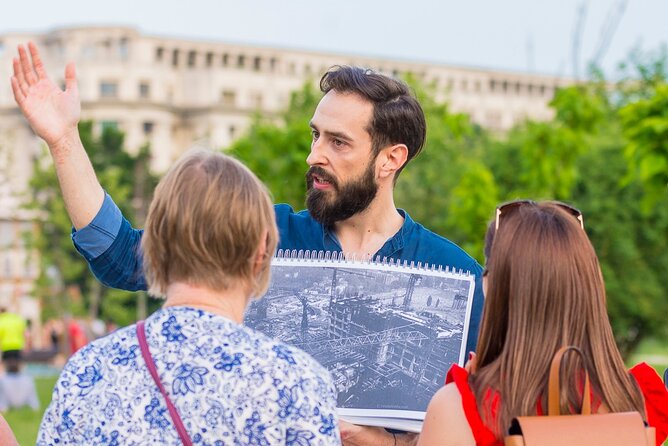
I like the way the route connects architecture with daily life, rather than treating communism as a string of dates. I also like the guides’ use of old photographs and personal stories. Laura is praised for her clear history background and warm style, while Tamar is noted for sharp answers and lively anecdotes. The main drawback is simple: you cover a lot of ground in roughly three and a half hours, and the Palace of Parliament admission fee is not included.
Key points to know before you go
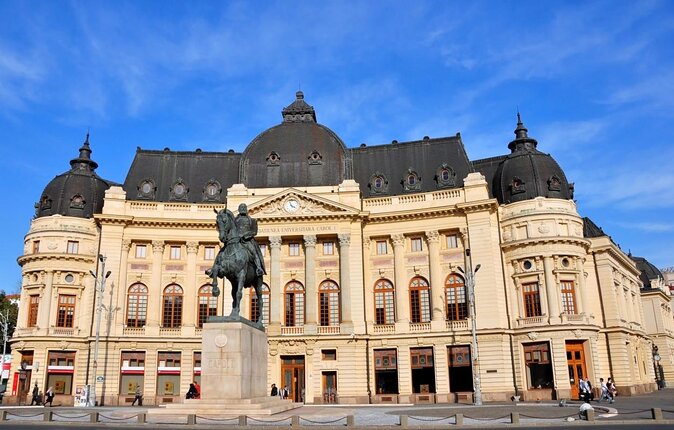
- Ceaușescu’s grand plan begins at Unirii Square: See the fountains and the former Victory of Socialism Boulevard as symbols of the dictator’s scale of ambition.
- The Palace of Parliament is viewed from outside: You learn how it was built and what it cost Romania, but interior admission is not part of this experience.
- Mihai Voda Monastery reveals what was nearly erased: A medieval church survived the demolition of nearby neighborhoods and buildings.
- Revolution Square brings 1989 into focus: See the former communist leadership buildings, Ceaușescu’s final speech balcony, and the memorial to those killed.
- Guides add photos and personal stories: Laura and Tamar are especially praised for making difficult history clear, human, and easy to discuss.
- The route ends near the Old Town: Revolution Square is about five minutes from Bucharest’s historic center.
Why communist Bucharest makes a good walking subject
Bucharest can look confusing at first. You may pass nineteenth-century buildings, concrete apartment blocks, grand government offices, churches squeezed behind newer structures, and wide roads built for political spectacle. This tour helps you read those contrasts.
Romania lived under communist rule for 45 years. That period changed not only government, but also housing, food supplies, religion, work, urban planning, and the way people used public space. The route gives you a useful framework for understanding those changes.
I especially like that the tour does not stop at Ceaușescu’s name. You also learn about the monarchy before communism, the rise of the socialist state, the effect of shortages during the 1980s, and the shift toward democracy after 1989. That wider frame matters. Without it, the Palace of Parliament is just a huge building and Revolution Square is just another city plaza.
The tour is led in English, based on the available information and comments about the guides’ English. Laura is repeatedly praised for mixing historical facts with stories from the communist period. Tamar is described as engaging, prepared, and happy to handle extra questions. Guide assignments can change, so you should not assume a particular person will lead your departure.
More communism and Ceausescu tours in Bucharest:
- The Real tour of Communism
★ 5.0 · 666 reviews - Life under Communism
★ 5.0 · 358 reviews - 3-Hour Guided Tour of Communist Bucharest
★ 4.9 · 303 reviews
Starting at Unirii Square and the Victory of Socialism Boulevard
The meeting point is at Piața Sfântul Anton 64, in central Bucharest. The tour begins at 4:00 pm and opens at Unirii Square, a sensible place to begin because the square was redesigned during the final phase of communism.
Unirii Square is known for its fountains and its position in the middle of the city. It is also connected to the former Victory of Socialism Boulevard, one of Bucharest’s most revealing communist-era spaces. The boulevard was planned on a huge scale, with the kind of long, commanding view that allowed the state to display power.
As you walk here, listen for the distinction between a useful city street and a political stage. The avenue was not simply built to improve traffic. It reflected Ceaușescu’s desire for a capital arranged around state ceremony, control, and his own image.
The stop lasts about 30 minutes and has no separate admission charge. That makes it a good opening lesson: you can understand a great deal from the layout of the city before entering a museum or government building.
Bring comfortable shoes. The route is a walking tour, and the meaning of each place depends on stopping, looking around, and moving between sites rather than remaining in one building.
The Palace of Parliament and the price of spectacle
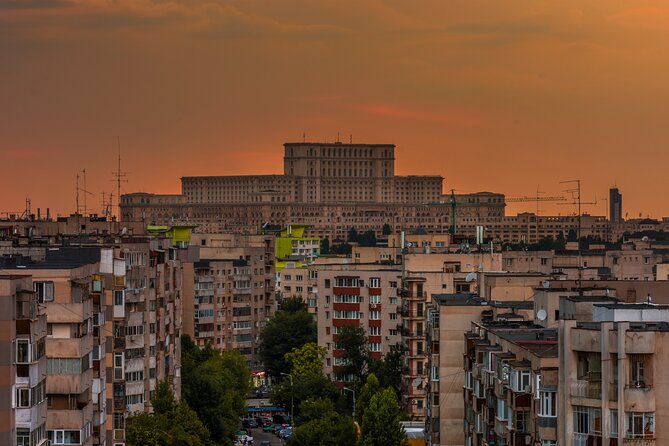
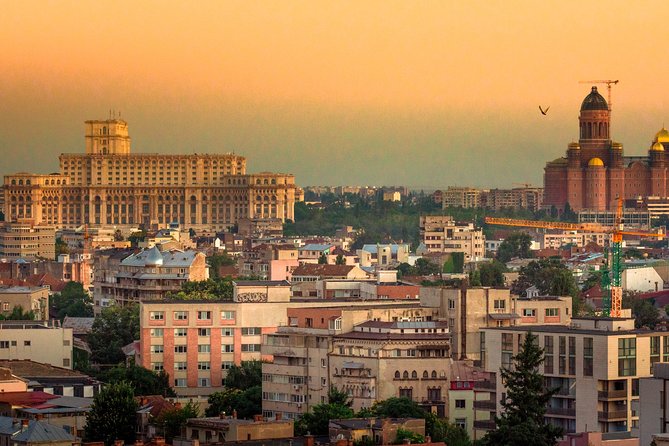
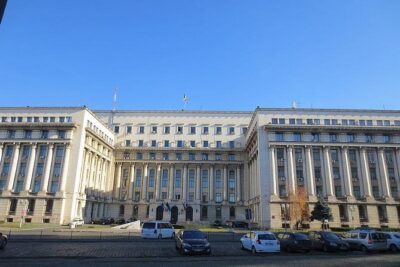
The Palace of Parliament is the tour’s largest physical sight and perhaps its most complicated one. It is described as the second-largest building in the world after the Pentagon and the most expensive administrative building. Its sheer size is hard to process from a single viewpoint, so the guide uses several angles to explain its scale.
You learn how the building was constructed during the 1980s, when ordinary Romanians faced severe shortages. Money, materials, and labor were directed toward a structure intended to express the power of the regime. The contrast is the point: while homes and shops lacked basic supplies, the state poured resources into a monumental government complex.
The guide also explains how local people view the building today. That is valuable because the Palace is not a simple symbol of pride or shame. It is a working part of Bucharest, a major architectural sight, and a reminder of the suffering imposed during its construction.
Across from the Palace is the Academia Romana building, another large project linked to the Ceaușescu period. It was intended for Elena Ceaușescu, the dictator’s wife. The guide uses this nearby structure to explain how the couple’s power shaped public architecture and political life.
The stop lasts about an hour. Admission to the Palace is not included, so expect to view and discuss it from outside rather than tour its interior as part of this walk. If entering the building is a priority, you will need to arrange that separately and allow extra time.
For me, this is where the tour’s value becomes clear. At $23.22 per person, you are paying for interpretation, not a ticketed attraction. The building is free to see from public areas, but understanding its construction, its human cost, and its place in Ceaușescu’s plans is much harder without context.
Mihai Voda Monastery and the churches that survived
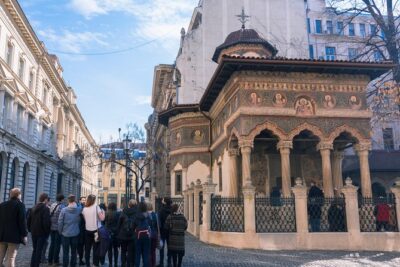
After the grand scale of the Palace, Mihai Voda Monastery offers a sharp change of mood. The church dates from the Middle Ages and survived the communist demolition campaign that destroyed or moved other religious buildings.
The stop explains how the communist authorities treated religion. Some churches were demolished. Others were moved, concealed, or left standing under difficult conditions. In Bucharest, churches hidden behind utilitarian apartment blocks can seem almost accidental until you learn why they are there.
Mihai Voda Church is important because it gives you a glimpse of the older city that existed before the broad avenues and concrete developments. It helps make the destruction of historic neighborhoods more concrete. You are not only hearing that Bucharest changed. You are seeing one of the buildings that escaped the most severe version of that change.
The stop lasts about 30 minutes and has no admission fee listed. It is also a useful pause in the route. The Palace represents command from above. The monastery represents continuity, memory, and the survival of something the state could not fully remove.
Keep your expectations realistic. This is not presented as a long church visit or a religious service. It is a short historical stop within a larger walking route, with the emphasis on communist urban policy and the fate of religious buildings.
Same city, a completely different sort of day:
- Bucharest: Dracula’s Castle, Peles Castle, & Brasov Old Town
★ 4.5 · 17,858 reviews - Bucharest: Dracula Castle, Peles Castle & Brasov Old Town
★ 4.6 · 10,891 reviews - Bucharest: Dracula’s Castle, Peleș Castle & Brașov Day Trip
★ 4.5 · 5,919 reviews - Bucharest: Palace of Parliament Tickets and Guide
★ 4.3 · 3,182 reviews
Revolution Square and Ceaușescu’s final public speech
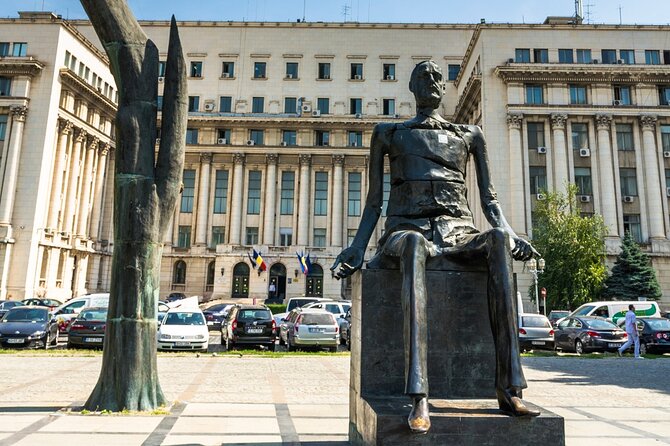
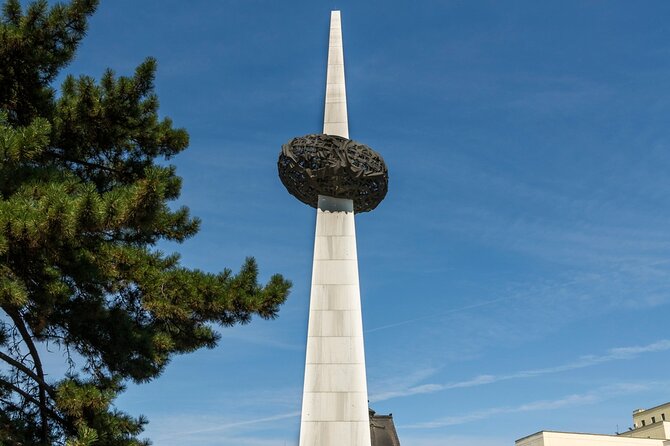
Revolution Square is the emotional center of the tour. This is where the communist regime began to collapse in public view during the protests of 1989.
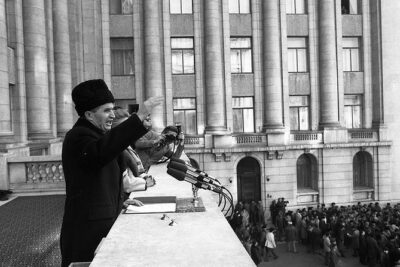
You see the building that housed Ceaușescu’s office and the balcony from which he gave his final speech. The significance of the place comes from the moment when a carefully managed public appearance broke down. The crowd no longer behaved as the regime expected, and the dictator’s authority began to fail in front of the country.
The guide also points out locations tied to the first mass demonstration in Bucharest. You learn what happened to people who protested, how the memorial to those killed came to be, and what followed after the Revolution.
This part of the tour requires attention. The story is not only about a dramatic speech or a dictator fleeing power. It is also about people who were injured or killed, the confusion surrounding the transition, and the difficult aftermath of the Revolution. The guide’s role is especially important here because the physical square alone cannot explain the competing memories attached to it.
The stop is scheduled for about an hour. Take time to look at the square before moving on. The buildings and monuments may appear familiar from photographs, but their meaning changes once you know how public demonstrations, state power, and violence met in this space.
The tour ends in or around Revolution Square, about five minutes from the Old Town. That is handy for dinner, a drink, or a second walk through central Bucharest after the formal tour ends.
University Square and the fight for a free society
University Square is linked to the main protests against communism in 1989. The site is associated with demonstrators who believed in a free society and with the violence that followed.
This stop gives the tour another important angle. Revolution Square shows the collapse of the leadership at the top. University Square brings the focus back to ordinary people in the streets. The cost of political change was not abstract. Hundreds were killed during the protests, according to the supplied tour information.
The guide connects the square to the wider story of public resistance and the transition from socialism to democracy. This is also a good place to ask questions. Several guide accounts emphasize that Laura and Tamar welcome questions and explain details beyond the prepared route.
There is a small logistical oddity in the supplied route: Revolution Square is listed as the final destination, while University Square also appears as a later stop. Treat the itinerary as a connected central-city walking route rather than expecting a perfectly linear sequence. Your guide will direct the group between the sites.
The guides make the difference
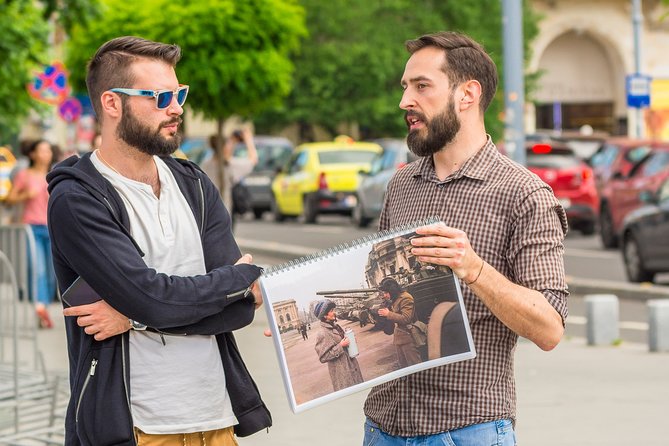
The strongest part of this experience is the guide-led explanation. Bucharest’s communist architecture is easy to see and easy to misunderstand. A guide can show you how a boulevard served political power, why a church appears behind a block, or how a public square became a place of protest.
Laura is described as a history graduate who uses photos to fill in the gaps between what you see now and what stood there before. She also adds personal stories about the communist period and gives local suggestions, including food tips. That combination is useful if this is your first day in Bucharest.
Tamar is described as prepared, friendly, and quick to answer additional questions. The tone appears to be informative without becoming stiff. Some accounts also mention humor and a stop at Bucharest’s oldest cake store, but that does not appear as a fixed part of the stated itinerary, so you should treat it as a possible guide choice rather than a promise.
The experience is listed as private, with a maximum of 15 people. That is a small enough group for questions, though not necessarily a one-to-one tour. If the group is small on your date, the guide can give more attention to individual interests. The schedule and guide may vary.
Timing, walking effort, and useful planning details
The tour begins at 4:00 pm and lasts about three hours and 30 minutes. That makes it a useful late-afternoon activity, especially if you want to spend the morning in the Old Town or at a museum.
You will walk between several central sites. The route includes open squares, broad avenues, government buildings, and historic religious sites. The supplied information says most people can participate, service animals are allowed, and the meeting point is near public transportation.
Because much of the experience takes place outdoors, weather matters. The tour requires good weather. If poor conditions cause cancellation, you are offered another date or a full refund.
The free cancellation window is 24 hours before the start time. Cancel at least that far ahead for a full refund. Late cancellations and changes are not accepted for a refund under the stated policy.
I would wear shoes suited to several hours on city pavement and bring water. Those are ordinary walking-tour precautions, but they matter more here because the route’s strength is the connection between sites. You will get less from it if you are tired and eager to rush through each stop.
Is $23.22 good value?
At $23.22 per person, this is a fair price for a guided central Bucharest history walk. The main value is the guide’s interpretation, not entry to a paid attraction. You receive about three and a half hours of structured context across several major sites, with a group limit of 15.
The price is especially reasonable if you are new to Bucharest or know little about Romania’s communist era. In one afternoon, you cover the final communist building projects, religious survival, Ceaușescu’s leadership, the shortages of the 1980s, and the protests of 1989.
The value is lower if you want a full interior visit to the Palace of Parliament. That admission is not included, and the Palace is discussed from outside. It is also not the best choice if you dislike long outdoor walks or prefer a museum-based presentation.
I would see this as a foundation tour. It gives you the political and urban background needed to understand other Bucharest sights. Afterward, you can return to the Palace, Revolution Square, or the Old Town with a much clearer sense of what you are looking at.
Who should book this Bucharest tour?
I would recommend it to first-time visitors, history-minded travelers, and anyone who wants to understand why Bucharest looks the way it does. It also suits people who prefer stories, photographs, and conversation over a silent sightseeing loop.
You do not need prior knowledge of Romanian history. The guides explain the move from monarchy to communism, the years of Ceaușescu’s rule, and the return toward democracy in a way that builds from the basics.
Romanians and repeat visitors can also find value here. The route includes details about Bucharest that are easy to miss, and the use of historic photographs helps connect present-day streets with the city that existed before the communist redevelopment.
I would skip it if your main goal is to tour the inside of the Palace of Parliament, since that is not part of the experience. I would also choose another activity if rain or cold would make three and a half hours outside unpleasant.
Should you book it?
Book this tour if you want a clear, human explanation of communist Bucharest rather than a quick list of monuments. The strongest elements are the contrast between Unirii Square and the Palace of Parliament, the survival of Mihai Voda Monastery, and the firsthand-feeling stories and photographs used by guides such as Laura and Tamar.
The main limits are the outdoor walking, the separate Palace admission, and the amount of history packed into one afternoon. For $23.22, though, it offers a useful introduction to Bucharest’s hardest and most important modern chapter. It is a smart first or second-day choice, especially if you want the city’s streets to make more sense.
FAQ
How long does the Bucharest Under Communism tour last?
The tour lasts approximately three hours and 30 minutes.
What time does the tour start?
The stated start time is 4:00 pm.
Where does the tour begin?
The meeting point is Piața Sfântul Anton 64 in Bucharest, Romania.
Where does the tour end?
The tour ends at Revolution Square, Piața Revoluției, about five minutes from the Old Town.
Is admission to the Palace of Parliament included?
No. Admission to the Palace of Parliament is not included. The tour explains and views the building from different angles.
What landmarks are included?
The route includes Unirii Square, the Palace of Parliament, Mihai Voda Monastery, Revolution Square, and University Square.
How large can the group be?
The experience has a maximum of 15 participants.
Is the tour suitable for most people?
The supplied information says most people can participate. The tour is a walking experience, and service animals are allowed.
Can I cancel for a full refund?
Yes. You can cancel at least 24 hours before the local start time for a full refund. Cancellations or changes made less than 24 hours before the start time are not refunded.
Newest Bucharest trips we have written up
- Bucharest: Dealu Mare Winery Private Trip with Wine Tasting★ 4.9 · 6 reviews
- Winery touring & private wine tasting – one day private tour★ 5.0 · 3 reviews
- Traditions in Bucharest: Village Museum and Wine Tasting★ 5.0 · 8 reviews
- Your rendez-vous with Europe’s past: time-travel to Maramures, Transylvania★ 5.0 · 6 reviews
- Village Museum Bucharest Guided Tour★ 5.0 · 6 reviews
- Private Wine Tasting at Bucharest’s First Wine Bar★ 5.0 · 3 reviews
- Walking Tour of Bucharest City Center – Private Tour★ 5.0 · 4 reviews
- Wine tasting in Bucharest Old town – bonus cheese platter★ 4.5 · 6 reviews
Bucharest Communism and Ceausescu Tours, compared.
Bucharest Essential Tour: Old Town, Calea Victoriei & Communism
Read our review →

Museum of Communism Ticket with Communist Coffee
Read our review →
Dinner+Tour at Museum of Communism after closing
Read our review →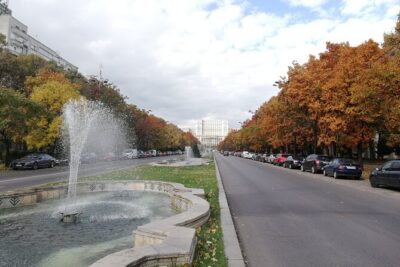
Contrasts of Communism – Small Group Walking Tour in Bucharest
Read our review →Browse the lists this tour appears in