
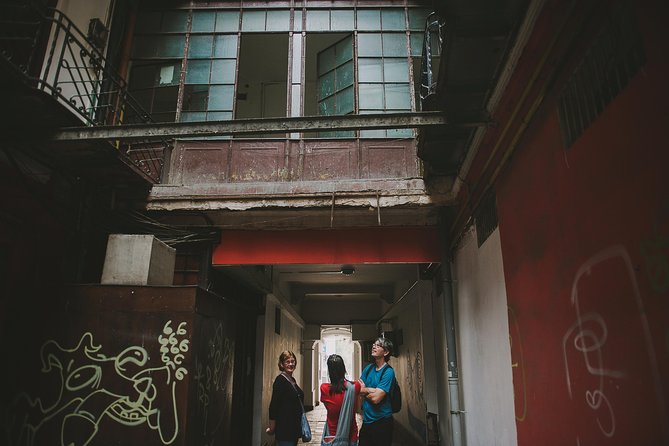
Reviewed · BUCHAREST DARK HISTORY AND GHOST TOURS
Darkside Tour of Bucharest – small group
Bucharest’s darkest stories are not locked in a museum. They sit beneath cemetery statues, on grand avenues, and in the squares where Romanians faced dictatorship and police violence. This small-group walk links Bellu Cemetery with the 1989 Revolution, old scandals, political protests, and the hard years of communism.
I like two things right away. First, the cemetery gives the tour a setting you would not find on a standard city walk. Second, the guides bring plenty of personality. Vlad, Alex, Andra, Elena, Bogdan, Irina, and others are praised for clear storytelling, humor, and thoughtful answers. The main caution is the subject matter: murder, death, repression, and political violence are central, so this is not a light sightseeing stroll.
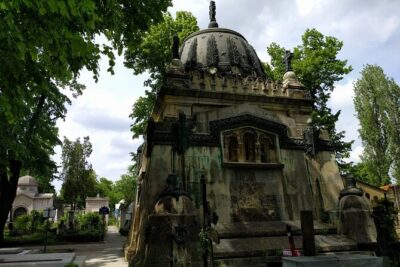
- Bellu Cemetery sets the tone: Spend about an hour among crypts, tombstones, statues, love stories, and unresolved mysteries.
- The metro is part of the route: Subway transport connects the starting point near the National Theatre with the cemetery.
- The 1989 Revolution feels close: Revolution Square explains the final days of Nicolae Ceausescu’s rule and the deaths of civilians.
- Small groups keep the walk personal: The maximum group size is 12, which gives you a better chance to ask questions.
- The stories reach beyond communism: You hear about old Bucharest scandals, famous characters, protests, corruption, and everyday life under the Iron Curtain.
- A street snack is included: It is a small but welcome touch during a three-hour walking experience.
Why Bucharest’s darker past works best on foot
This tour is built around a simple idea: the city makes more sense when you connect its places to the people who lived through them. You are not just shown a monument. You hear why a square mattered, who gathered there, and how an event still affects Romania today.
The route moves from Bellu Cemetery to University Square, then along Calea Victoriei before ending at Revolution Square. That order gives the walk a useful shape. You begin with personal stories and memorials, move into public protest, then look at the city’s social life before reaching the most painful political chapter.
The English-speaking guides use history, folklore, local customs, and humor. That mix matters. A list of dates would make the tour feel heavy, but the personal stories help you remember the larger events. Elena, for example, is praised for connecting folklore and family experience with the places you see. Vlad is singled out for strong anecdotes and an easy command of English. Alex is noted for answering questions openly and adding humor even when the subject is grim.
You should still expect different guiding styles. The company uses several guides, including Vlad, Andra, Alex, Elena, Bogdan, Irina, and others. The strongest common thread is storytelling, but the exact tone will depend on who leads your group.
Bellu Cemetery, one hour among Bucharest’s dead
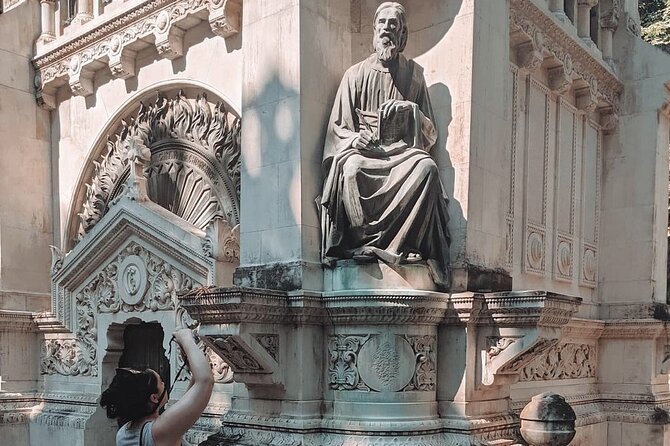
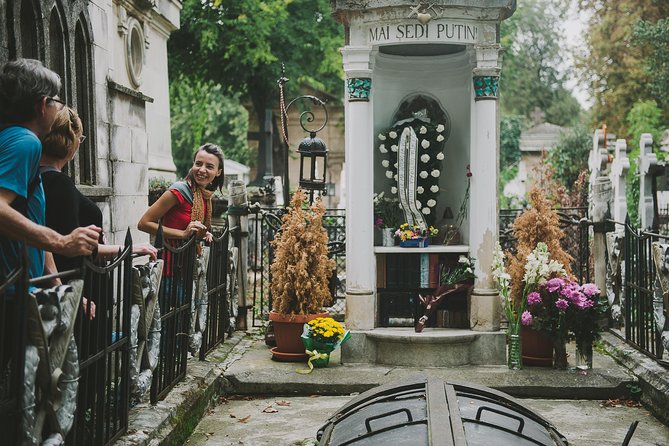
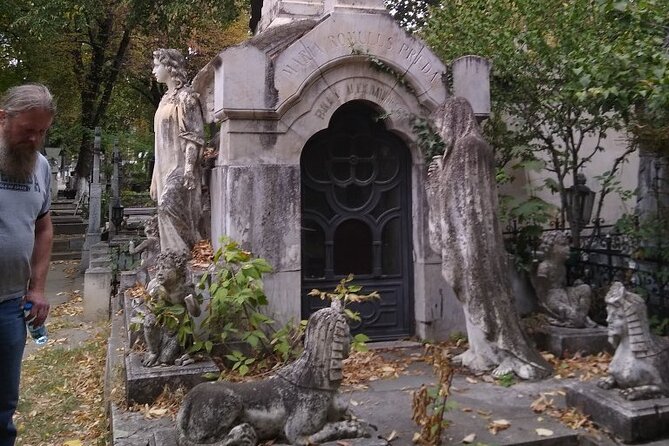
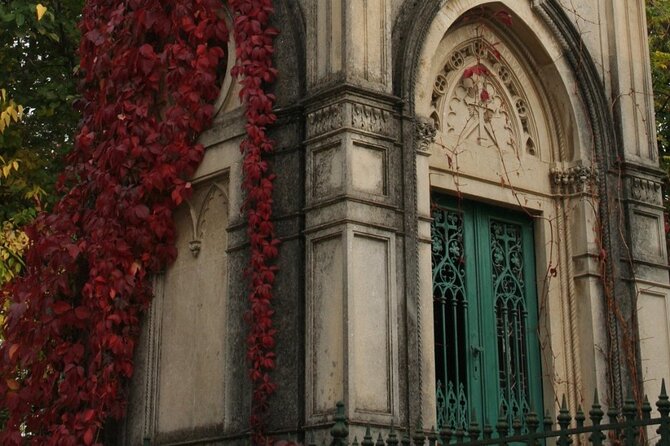
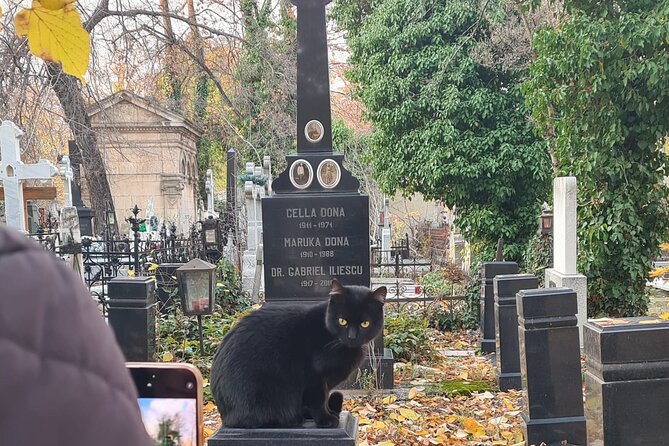
Bellu Cemetery, also called Cimitirul Serban Voda-Bellu, is the heart of the tour. It is described as Bucharest’s first modern graveyard, and the visit lasts about an hour. Admission is included at no extra charge.
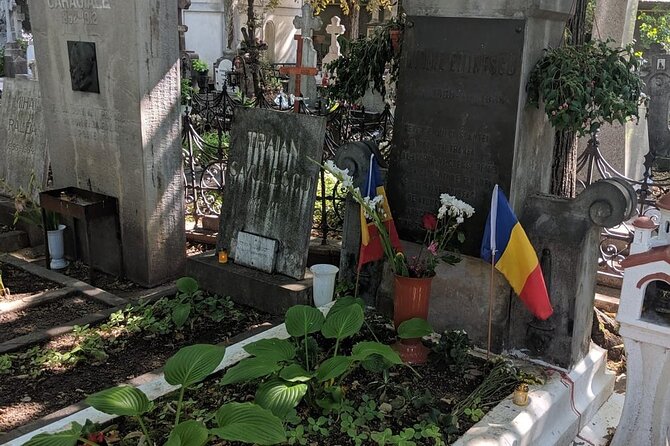
This is not simply a stop to admire old graves. The guide uses monuments, crypts, tombstones, and unusual memorials to tell stories about love, loss, social life, and mystery. The setting lets you see how Bucharest remembers its artists, public figures, and troubled characters.
The cemetery is also where the tour’s mood becomes clear. You may hear stories about people who met strange or violent ends, along with local legends and personal details. Some stories carry a touch of humor. That balance is useful because the subject can otherwise become relentlessly bleak.
Give this stop your full attention. Several people who enjoyed the tour said they could have spent much longer in the cemetery. That makes sense: the grounds provide the most unusual setting, and the details are easy to miss if you rush from monument to monument.
The practical issue is walking comfort. You need a moderate level of fitness, and the overall experience takes place on foot with subway travel between sections. Wear sensible shoes and prepare for outdoor conditions. The tour requires good weather, so a poor forecast can lead to a new date or a full refund.
More dark history and ghost walks in Bucharest:
- Bucharest: 3-Hour Dark History Tour with a Local
★ 4.9 · 301 reviews - Bucharest Ghosts Stories and Mythology
★ 5.0 · 292 reviews - Bucharest: Ghost Stories & Romanian Mythology Walking Tour
★ 4.9 · 287 reviews
University Square and the story of public protest
After the cemetery, the route turns toward University Square. The stop lasts about 20 minutes, but its importance reaches far beyond that short time.
This is presented as the starting point for several major protest movements in recent Romanian history. You hear about the victims of the 1989 Revolution, people who wanted a more Western future, clashes with miners in the 1990s, and the later fight against corruption.
That range is one of the tour’s strengths. Bucharest’s political story did not end when communism fell. The square remained a place where people challenged power, demanded change, and argued over the country’s direction.
For you, the value lies in the connection between past and present. A standard sightseeing walk may identify a square and point out nearby buildings. This tour explains why the space carries emotional weight for Romanians and why recent events still shape public life.
The stop is short, so do not expect a full political seminar. Instead, think of it as a compact bridge between the personal stories at Bellu and the larger political story that ends at Revolution Square.
Calea Victoriei and Bucharest before communism
Calea Victoriei brings a different kind of darkness. Here, the guide looks back to Bucharest in the early 20th century, before the Communist regime took power.
The focus includes the city’s scandals, nightlife, prostitution, and colorful figures from the period. One striking detail is the estimate that about 12,000 prostitutes and escorts were working in Romania in 1927. You also hear about Zaraza, a beautiful Roma dancer whose story has become part of Bucharest’s urban folklore.
This section helps prevent a common mistake: treating Romanian history as a straight line from old monarchy to communism. Bucharest before the dictatorship had its own social tensions, pleasures, scandals, and inequalities. The city was not simply waiting for the next political era.
Calea Victoriei is also a useful place for this theme because it is one of Bucharest’s major historic avenues. You can pay attention to the contrast between the formal city around you and the less polished stories being told. That contrast gives the walk some bite.
The subject may not suit everyone. The discussion of prostitution and scandal is part of the tour’s appeal, but families looking for a gentle introduction to Bucharest should choose another route. The experience is not recommended for children aged 15 and under.
Revolution Square and the end of Ceausescu’s rule
The final stop is Revolution Square, in front of the Ministry of Internal Affairs. The tour ends here after about 20 minutes of discussion focused on Romania’s communist period and the events of December 1989.
This is the most emotional section. The guide explains the Romanian gulag, life under Nicolae Ceausescu, the hardship of the 1980s, and the shootings that took place on December 22, 1989. Civilians faced the Securitate, the secret police, and many innocent people died.
The square represents the symbolic end of communist rule in Romania. The guide explains how that change happened rather than reducing it to a simple date in a textbook.
I find this ending effective because the route has already shown you individual lives, public protests, and the social world of earlier Bucharest. By the time you reach Revolution Square, the political story feels connected to real people and places.
You should allow yourself time afterward. The tour ends here, not back at the starting point, so you can continue exploring central Bucharest or make your own way elsewhere. The final subject matter can also leave you thoughtful rather than cheerful. That is part of the point, but it is worth knowing before you book.
Same city, a completely different sort of day:
- Bucharest: Dracula’s Castle, Peles Castle, & Brasov Old Town
★ 4.5 · 17,858 reviews - Bucharest: Dracula Castle, Peles Castle & Brasov Old Town
★ 4.6 · 10,891 reviews - Bucharest: Dracula’s Castle, Peleș Castle & Brașov Day Trip
★ 4.5 · 5,919 reviews - Bucharest: Palace of Parliament Tickets and Guide
★ 4.3 · 3,182 reviews
What the guides add to the experience
The guides are a major reason this tour earns such strong marks. The overall rating is 4.9 from 139 ratings, and 98 percent of customers recommend it. More important than the numbers is the pattern in the feedback: people repeatedly praise clear explanations, warmth, humor, and enthusiasm.
Vlad receives special praise for his anecdotes, English, and passion for the subject. One guide handled a heat index of 38 C by providing enough water and checking that nobody became too hot. That is the sort of practical care that matters on a summer walking tour.
Alex is praised for his grasp of Romanian history and the Revolution, as well as his open, relaxed manner. One person also appreciated that he helped when the pickup directions were unclear. Andra is described as passionate and skilled at keeping history exciting. Elena is praised for making the stories feel personal, adding humor, and offering local recommendations.
You may also get small human touches rather than a rigid script. One guide stopped to feed cats, and another brought a pretzel as the included street snack. These details do not change the route, but they can make the experience feel more like time with a local than a formal lecture.
Because several guides lead the tour, you cannot expect one exact personality every time. Still, the repeated praise points to a clear strength: the company places real weight on storytelling and conversation.
The group size, timing, and physical demands
The tour begins at 3:00 pm near the Ion Luca Caragiale National Theatre, at Bulevardul Nicolae Balcescu 2. It finishes at Revolution Square, in front of the Ministry of Internal Affairs.
The maximum group size is 12. That is small enough for questions and easier street movement, while still giving the tour a social feel. If you prefer a private guide or complete control over the pace, this is not that kind of outing.
Subway transportation is included, and the route is mainly a walking experience. You should be comfortable walking outdoors, using public transport, and spending time in a cemetery. The tour is near public transportation, and service animals are allowed.
The afternoon start is useful in warm weather, though conditions can vary. Bring water, especially in summer. The company includes a street snack, but other food and drinks are not included, so do not treat the snack as a meal.
Is $48.39 a fair price?
At $48.39 per person, the tour is not the cheapest way to see Bucharest. It is also more than a basic free walking tour. The value comes from the combination of a local English-speaking guide, a carefully linked route, subway transport, a snack, and a group capped at 12.
Bellu Cemetery alone gives the experience a point of difference. Add the political context at University Square and Revolution Square, plus the social history along Calea Victoriei, and you get more than a collection of spooky tales.
The tour lasts about three hours, which is long enough to build a story without taking over your entire day. If you want a broad introduction to Bucharest’s churches, architecture, food, and main attractions, spend your money elsewhere. If you want a focused look at difficult chapters and unusual local stories, the price is reasonable.
The fact that the tour is often booked 32 days ahead suggests you should not leave it until the last minute, especially if your dates in Bucharest are fixed.
Who should book this walk?
I would choose this experience if you have already seen a few standard sights or if you want your first Bucharest tour to explain the city’s character rather than simply list monuments.
It suits:
- History-minded adults and older teenagers
- People interested in communism and the 1989 Revolution
- Visitors who enjoy cemeteries, folklore, mysteries, and unusual biographies
- Curious walkers who like asking questions
- Anyone who wants a small group instead of a large coach
I would skip it if you want a cheerful, family-focused city tour, dislike discussions of death and political violence, or have trouble walking for several hours. It is not recommended for children aged 15 and under.
Free cancellation is available if you cancel at least 24 hours before the start time. Changes made within 24 hours are not accepted, and a weather cancellation brings the choice of another date or a full refund.
Should you book the Darkside Tour of Bucharest?
Book it if you want the Bucharest that standard sightseeing often leaves out: cemetery legends, old scandals, protest movements, secret police, and the human cost of dictatorship.
The best reason to go is Bellu Cemetery, but the full route matters. The cemetery gives you intimate stories, University Square shows how public resistance continued, Calea Victoriei adds social history, and Revolution Square explains the fall of communism.
At $48.39, it earns its price through the small group, transport, snack, and strong guiding rather than through entry tickets. Choose it for substance, personality, and a more complicated picture of Romania. Skip it only if the dark material sounds draining or you want a lighter introduction to Bucharest.
FAQ
How long does the Darkside Tour of Bucharest last?
The tour lasts approximately three hours.
Where does the tour begin?
It begins at the Ion Luca Caragiale National Theatre, Bulevardul Nicolae Balcescu 2, Bucharest.
Where does the tour end?
The tour ends at Revolution Square, in front of the Ministry of Internal Affairs.
What time does the tour start?
The scheduled start time is 3:00 pm.
Is transportation included?
Yes. Subway transportation is included in the experience.
Is Bellu Cemetery admission included?
Yes. The cemetery stop has no separate admission charge.
Is the tour suitable for children?
The tour is not recommended for children aged 15 and under. Participants should also have a moderate level of physical fitness.
Newest Bucharest trips we have written up
- Bucharest: Dealu Mare Winery Private Trip with Wine Tasting★ 4.9 · 6 reviews
- Winery touring & private wine tasting – one day private tour★ 5.0 · 3 reviews
- Traditions in Bucharest: Village Museum and Wine Tasting★ 5.0 · 8 reviews
- Your rendez-vous with Europe’s past: time-travel to Maramures, Transylvania★ 5.0 · 6 reviews
- Village Museum Bucharest Guided Tour★ 5.0 · 6 reviews
- Private Wine Tasting at Bucharest’s First Wine Bar★ 5.0 · 3 reviews
- Walking Tour of Bucharest City Center – Private Tour★ 5.0 · 4 reviews
- Wine tasting in Bucharest Old town – bonus cheese platter★ 4.5 · 6 reviews
Bucharest Dark History and Ghost Tours, compared.


Ghost Stories & Romanian Mythology Walking Tour
Read our review →
Abandoned and haunted military base – the ghosts tour
Read our review →Browse the lists this tour appears in