
Reviewed · BUCHAREST WALKING TOURS
Bucharest: Guided Walking Tour with Romanian Snack
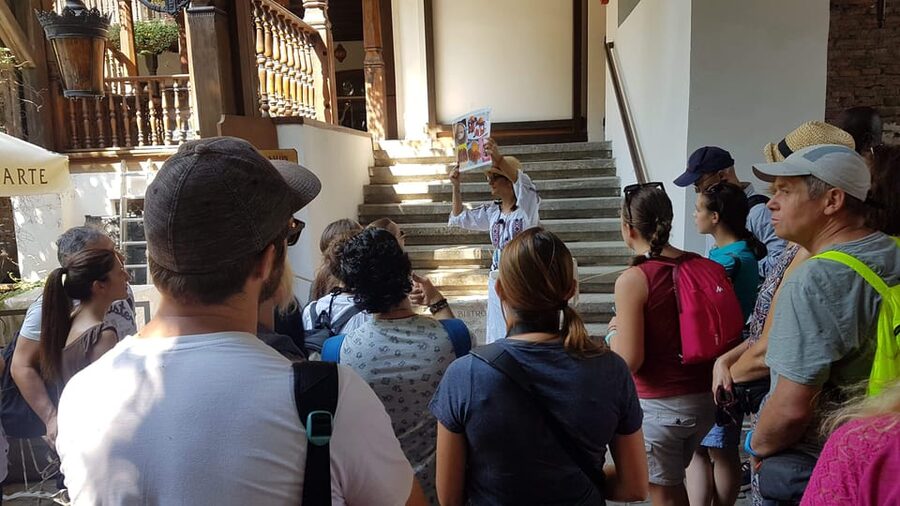
Bucharest’s story makes the most sense when you walk it in layers. This three-hour route moves from medieval court ruins to French-style boulevards, then into the painful memories of communism and the 1989 Revolution. Mara, Elena, Julian, and other local guides lead the way, depending on the date.
I like two things here. First, the route gives you a useful first look at central Bucharest without rushing from one photo stop to the next. Second, the small groups, capped at 10, leave room for questions, restaurant tips, and personal stories. The main drawback is the price: at $45, it costs more than many basic city walks, though the local context and small-group format help explain the difference.
Key points at a glance
- A 500-year walk through central Bucharest: See the old court, medieval churches, 19th-century boulevards, and Revolution Square in one route.
- A local guide makes the difference: Guides including Mara, Elena, Julian, Andrea, and Mihaela bring history, politics, food, and daily life into the walk.
- Small groups keep it personal: With no more than 10 people, you can ask questions and adjust the conversation to your interests.
- The tour connects beauty with difficult history: Palace architecture and elegant facades sit beside stories of dictatorship, demolition, and the 1989 uprising.
- A Romanian snack is included: The food stop adds a simple local taste to a history-focused outing.
- The finish is near the Romanian Athenaeum: You can optionally visit this famous concert hall for 15 lei, paid in cash.
Why this walk is a smart first look at Bucharest
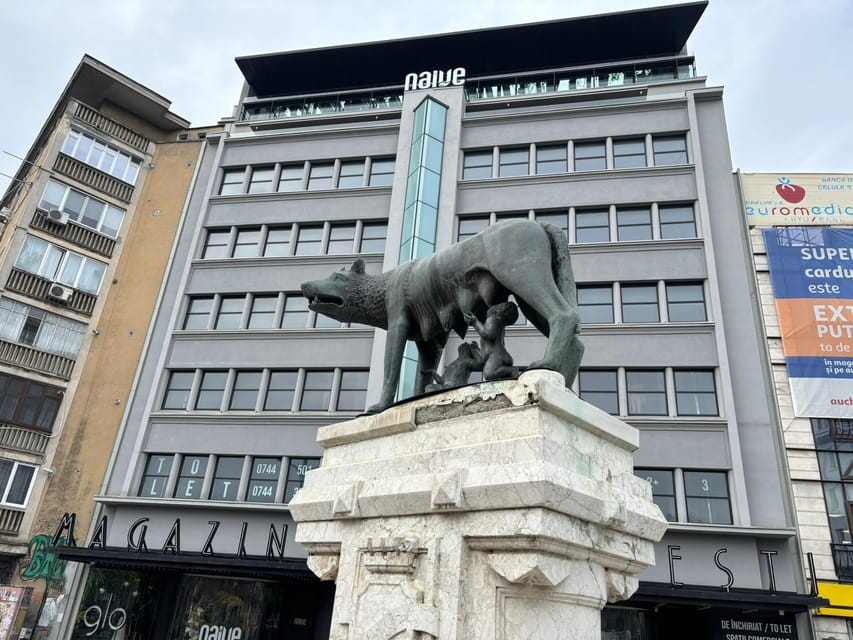
This is not just a checklist of Bucharest’s major sights. The route gives you a rough map of how the city changed over time. You begin with the medieval center, move through the period when Bucharest copied Parisian styles, and finish with modern Romania’s break from communist rule.
That order matters. Bucharest can feel scattered when you first arrive. Grand government buildings, old churches, cafés, busy streets, and worn facades often sit close together without an obvious explanation. A guide helps connect those pieces.
I also like the scale. Three hours is long enough to cover the center but short enough to fit into a first full day. Many people use this kind of walk early in a stay, then return to the places they want to explore more fully. The tour is especially useful if you have only a short visit and want both the main sights and a few places you would likely pass by alone.
The pace is manageable rather than athletic, but it is still a city walk. Wear shoes suited to pavement and allow room for stops, photos, and questions. In warm weather, the evening departure offered on some dates can be a good choice. One guide made shaded pauses and breaks when needed, and another adjusted the pace for winter snow and ice.
More Bucharest walking tours:
- Bucharest: City Highlights Guided Walking Tour
★ 4.9 · 1,482 reviews - Bucharest Highlights Walking Tour
★ 5.0 · 469 reviews - Bucharest: Ghost Stories & Romanian Mythology Walking Tour
★ 4.9 · 287 reviews
Starting at Unirii Square and the Palace of the Parliament
Meet in front of One Sip cafe on Unirii Boulevard. The closest metro station is Piata Unirii, which makes the starting point fairly easy to reach from other parts of the city.
The opening view is a big one: the Palace of the Parliament. The building is often described by its size, and you will understand why when it fills the horizon. It is the second-largest building in the world, and its scale introduces one of the central subjects of the tour: how communist power reshaped Bucharest.
You should not expect an interior visit to the palace on this walk. The value of the stop is the outside view and the explanation around it. A guide can help you understand what this enormous structure meant for the city, rather than leaving it as a giant, hard-to-place building in a photograph.
This first stop also gives you a useful contrast. Bucharest is not only old churches and elegant 19th-century buildings. Its modern story includes sweeping plans, forced change, and architecture used to display authority.
The old court, St. Anthony’s Church, and Manuc’s Inn
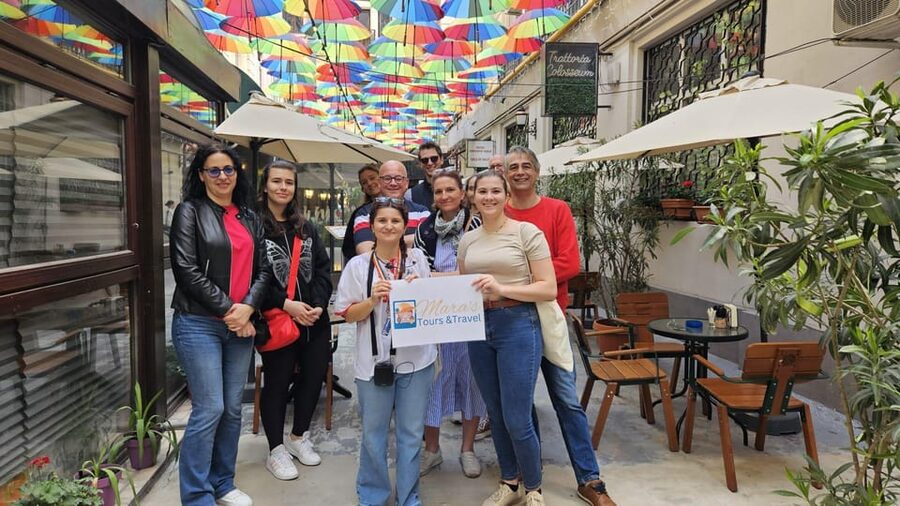
From Unirii Square, the walk turns toward the older center. Hanu’ lui Manuc, or Manuc’s Inn, is one of the first places where you get a feel for Bucharest before its grand boulevards took shape. The historic inn helps set up the story of trade, movement, and urban life in the old town.
St. Anthony’s Church follows. It is presented as the oldest church in the city, giving you a rare chance to see a surviving religious building in the middle of the central district. The stop is brief, but it helps show how much older Bucharest is than its 19th-century reputation suggests.
The ruins of the former Royal Court add another layer. This was once the seat of the rulers of Wallachia, and its remains offer a direct link to the medieval city. You will not see a fully restored palace complex here. Instead, the broken walls and archaeological remains ask you to picture a capital that looked very different from today’s café-lined streets.
I find these early stops especially useful because they prevent Bucharest from being reduced to Little Paris. The city has a medieval core, a royal past, a religious history, and a modern identity shaped by communism. The guide brings those periods together as you walk.
Stavropoleos Monastery and the changing Old Town

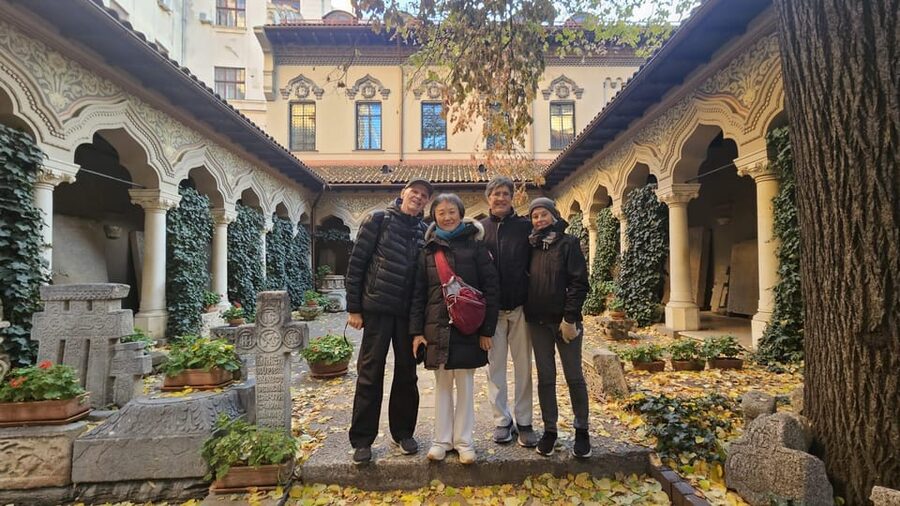
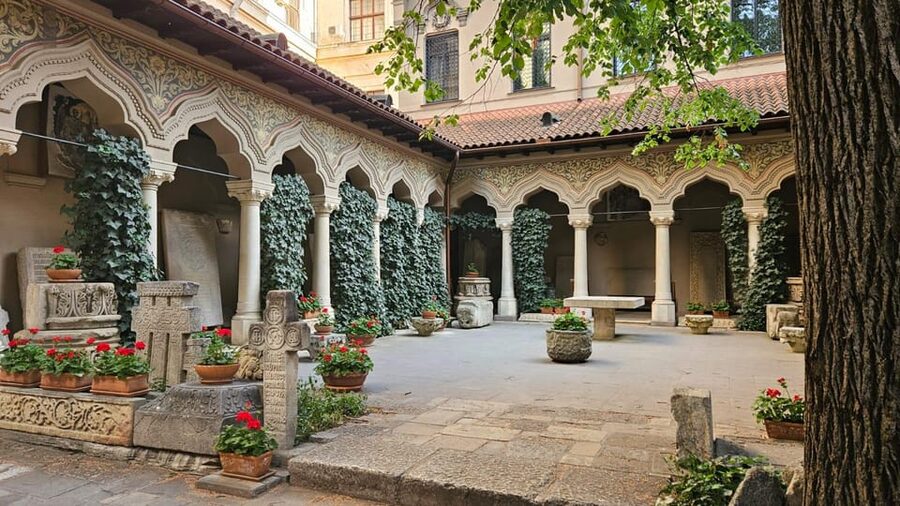
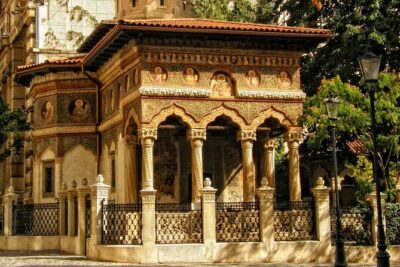
Stavropoleos Monastery is one of the prettiest stops on the route. Its carved stone details, intimate courtyard, and religious architecture offer a quieter pause from the traffic and crowds of the surrounding streets.
The visit is relatively short, so think of it as an architectural stop rather than a long museum visit. You will have time to look closely, take pictures, and hear about the site, but not enough time for a slow independent examination of every detail.
The surrounding Old Town has changed greatly. What was once a medieval commercial district is now the center of Bucharest’s nightlife, restaurants, and cafés. That change is worth discussing because the district can look old while functioning as a very modern entertainment zone.
You will see handsome historic buildings alongside signs of wear and commercial activity. That mixed condition is part of the experience. Bucharest’s center is not a perfectly restored historic quarter. It feels lived in, used, and occasionally rough around the edges.
Same city, a completely different sort of day:
- Bucharest: Dracula’s Castle, Peles Castle, & Brasov Old Town
★ 4.5 · 17,858 reviews - Bucharest: Dracula Castle, Peles Castle & Brasov Old Town
★ 4.6 · 10,891 reviews - Bucharest: Dracula’s Castle, Peleș Castle & Brașov Day Trip
★ 4.5 · 5,919 reviews - Bucharest: Palace of Parliament Tickets and Guide
★ 4.3 · 3,182 reviews
Cărturești Carusel and a modern pause
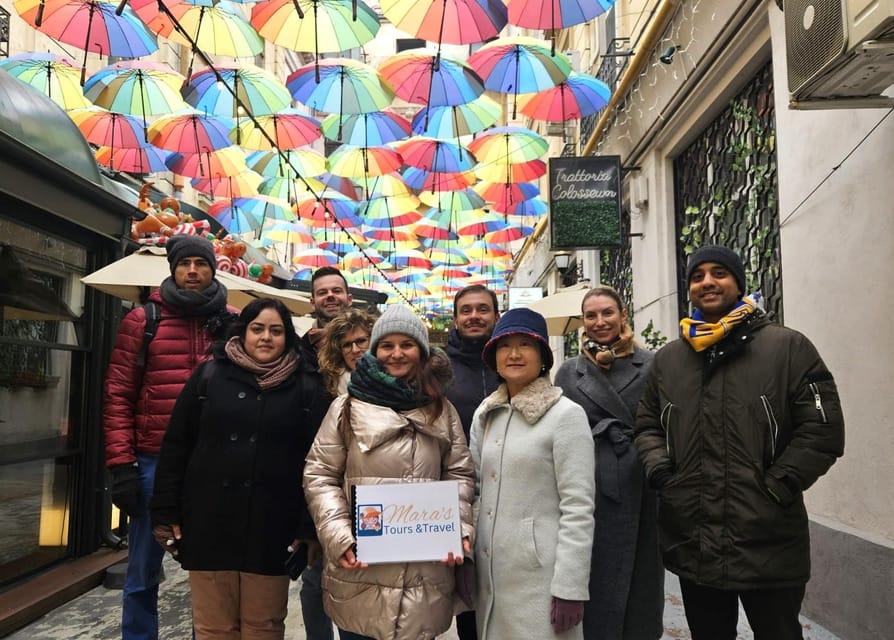
Cărturești Carusel is a memorable bookshop in the Old Town, known for its bright interior, sweeping balconies, and elegant design. It is an easy place to appreciate how Bucharest uses old buildings for new purposes.
The stop lasts about 10 minutes, so you will likely see the main interior rather than settle in with a book. Still, it breaks up the history with a contemporary cultural space and gives you one of the route’s best indoor photo opportunities.
This is also a good example of the tour’s balance. You are not walking only through ruins and monuments. You are seeing how the city’s historic center works today, including shops and social spaces that have taken over older buildings.
Calea Victoriei and the era of Little Paris
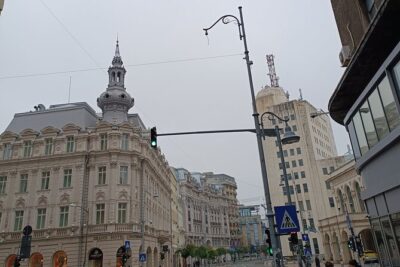
Calea Victoriei is the architectural centerpiece of the walk. Along this major avenue, your guide points out the French influence that earned Bucharest its old nickname, Little Paris.
Expect a mix of grand facades, decorative details, and important city buildings. The walk here is less about one single monument and more about reading the street as a whole. Bucharest’s late 18th- and 19th-century development brought a new urban style, and Calea Victoriei shows that ambition clearly.
This section also helps explain why Bucharest can surprise you. The city is not uniformly polished, yet a beautifully detailed facade may appear just beyond a plain or weathered building. Look upward as you walk. Some of the best details are above street level.
The guide’s commentary matters most here. A list of building names would be easy to forget, while stories about changing tastes, city life, and Romanian society give the architecture a reason to matter.
Revolution Square and the end of communist rule

The route then reaches Revolution Square, where the tone changes. This is the place to discuss what communist rule meant for Romania and how Bucharest changed after the events of 1989.
The square is not simply another grand urban space. It is tied to the fall of Nicolae Ceaușescu’s regime and the public events that marked Romania’s break with communism. This part of the tour gives you a chance to ask direct questions about politics, daily life, and the country’s transition.
Several people who took the walk valued the use of historical photographs and personal explanations here. That approach helps you compare the present-day square with its earlier appearance. It also makes the events easier to picture than a simple date-and-name lecture.
The subject can be serious, but the best guides keep the conversation open and clear. Mara has been praised for adding family stories and personal context, while Elena has been noted for explaining politics and culture with warmth and humor. Your guide may differ, but the format leaves room for a real conversation rather than a fixed speech.
Carol I and the Romanian Athenaeum
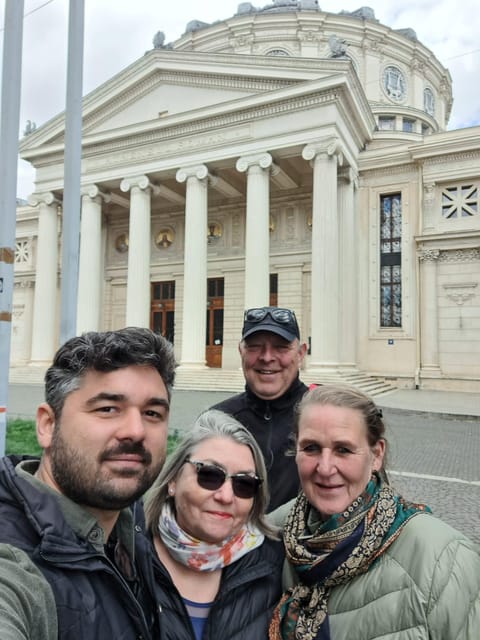
The final stops include the Equestrian Statue of Carol I and the Romanian Athenaeum. Carol I ruled Romania for decades and is closely linked with the country’s modernization, so the statue provides a fitting link between the royal period and the city’s grand public architecture.
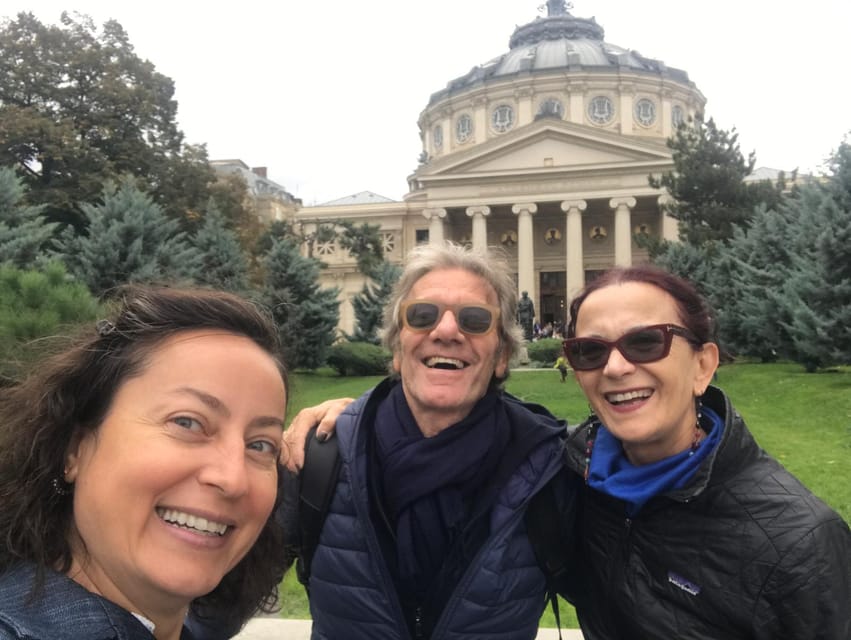
The walk ends at the Romanian Athenaeum, one of Bucharest’s best-known cultural buildings. The tour does not include admission, but you can enter for 15 lei, about 3 euros, in cash. If you have time, this is a useful add-on, especially if you enjoy concert halls and ornate interiors.
Keep that cash requirement in mind. The entrance is optional, but the tour price does not cover it. Ending here also gives you a convenient point from which to continue sightseeing around central Bucharest.
What the guides add to the experience
The named guides associated with this walk include Mara, Elena, Julian, Andrea, and Mihaela. Since the guide depends on the date, you cannot book around one specific person unless the operator confirms that in advance.
The strongest feature across the guide team is the ability to explain history in plain language. Mara is known for answering questions, adding family stories, and mixing historical facts with suggestions for cafés and restaurants. Elena brings energy, humor, and a friendly manner, while Julian has been praised for clear explanations and flexibility.
Mihaela and Andrea have also led the route, and the small group allows the guide to respond to the people in front of them. On some dates, the group has been as small as two people, creating something close to a private walk. That is not guaranteed, but the limit of 10 still gives you a better chance to speak up than a large coach tour.
The advertised languages are English and Italian, while the tour runs in English. If English is not comfortable for you, confirm the language arrangement before booking.
The Romanian snack and the $45 question
One Romanian snack is included. The food element is modest, not a full meal, but it gives the walk a local taste and a natural break. One guide took the group to a pastry shop for a sandwich, and the stop worked well for people who needed something more filling during three hours on foot.
Do not book this expecting a food tour. The main product is history, architecture, and conversation. The snack is a pleasant extra, and the exact item may vary.
At $45 per person, this is not Bucharest’s cheapest walking option. If your priority is simply seeing the sights, you may find less expensive group walks. The value here comes from the small group, local guide, broad historical range, and time for questions.
I would consider it worthwhile if you are visiting Bucharest for the first time, have limited time, or want more than a set of monument photographs. It is less compelling if you already know the central district well or prefer to explore at your own pace without scheduled stops.
Who should book this Bucharest walk?
I would recommend it to first-time visitors, couples, solo visitors, and small groups who want a clear introduction to the city. It also suits people who enjoy history but do not want a formal museum lecture.
Families can make it work too. One guide included young children in the conversation, and the route has enough variety to hold attention: ruins, churches, architecture, bookstores, public squares, and a snack stop.
The walk is also useful for solo visitors who want local suggestions for the rest of their stay. Guides have helped people choose restaurants, cafés, and further reading about Romania under communism.
You should think twice if you dislike walking, need a fully indoor activity, or want extended entrance time at each site. Most stops are seen from outside or visited briefly, and the appeal is the flow between places.
Should you book it?
Book this tour if you want Bucharest explained as a city of overlapping periods, not just a collection of pretty buildings. The route covers the old court, churches, the Old Town, Calea Victoriei, Revolution Square, and the Athenaeum while leaving room for questions and practical advice.
The strongest reasons to choose it are the small group, the range of subjects, and the guides’ personal approach. The main caution is cost. At $45, you are paying for interpretation and attention, not admissions or a large food tasting.
For a first day in Bucharest, I think the price can make sense. Take it early, note the places you want to revisit, and ask for local dining suggestions. If you want the least expensive possible city walk, choose another option. If you want a friendly, thoughtful introduction to Romania’s capital, this is a solid booking.
FAQ
Where does the tour start?
Meet in front of One Sip cafe on Unirii Boulevard. The closest metro station is Piata Unirii.
How long does the tour last?
The walking tour lasts three hours.
What languages are available?
The tour is offered in English and Italian, but the tour runs in English.
How large is the group?
The group is limited to 10 participants.
Is a Romanian snack included?
Yes. One famous Romanian snack is included in the tour price.
Can I visit the Romanian Athenaeum inside?
Yes, but entrance is optional and costs 15 lei, about 3 euros. Payment is cash only.
What happens if I need to cancel?
You can cancel up to 24 hours in advance for a full refund. You can also reserve now and pay later.
Newest Bucharest trips we have written up
- Bucharest: Dealu Mare Winery Private Trip with Wine Tasting★ 4.9 · 6 reviews
- Winery touring & private wine tasting – one day private tour★ 5.0 · 3 reviews
- Traditions in Bucharest: Village Museum and Wine Tasting★ 5.0 · 8 reviews
- Your rendez-vous with Europe’s past: time-travel to Maramures, Transylvania★ 5.0 · 6 reviews
- Village Museum Bucharest Guided Tour★ 5.0 · 6 reviews
- Private Wine Tasting at Bucharest’s First Wine Bar★ 5.0 · 3 reviews
- Walking Tour of Bucharest City Center – Private Tour★ 5.0 · 4 reviews
- Wine tasting in Bucharest Old town – bonus cheese platter★ 4.5 · 6 reviews
Bucharest Walking Tours, compared.


Ghost Stories & Romanian Mythology Walking Tour
Read our review →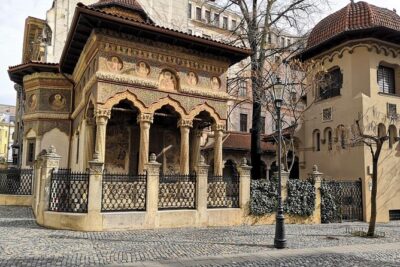
Walking Tour- Delightful Bucharest (Highlights, Stories, Sights)
Read our review →
4h Bucharest Private Tour (2h by Car and 2h Walking in Old Town)
Read our review →
Browse the lists this tour appears in