
Reviewed · BUCHAREST WALKING TOURS
Bucharest: private and exclusive Italian walking tour
Bucharest reveals itself in layers on this private Italian walking tour. In two and a half hours, you move from medieval churches and Ottoman-era buildings to elegant boulevards, royal landmarks, and the square where Ceaușescu’s rule ended. The city’s past and present sit surprisingly close together.
I like the one-to-one flexibility and the route’s variety. Your guide can adjust the pace and explain why places such as Stavropoleos Monastery, Calea Victoriei, and Revolution Square matter, rather than simply pointing them out. I also like the Italian-language focus, especially with guides such as Giuseppe, also called Beppe, and Filippo Di Cataldo associated with the experience.
The main consideration is walking comfort. The tour covers several historic streets and lasts 2.5 hours, and the information gives mixed signals about accessibility: it is marked wheelchair accessible but also listed as unsuitable for people with mobility impairments. Ask for clarification before booking if that affects you.
Key points to know before you book
- Private Italian-language guiding: You get a certified guide and a tour shaped around your group, rather than a fixed large-group script.
- Three faces of Bucharest: The route connects the Old Town, polished Calea Victoriei, and politically charged Revolution Square.
- Strong architectural range: Expect Orthodox churches, a grand bank, royal buildings, Art Nouveau details, restaurants, and modern street life.
- History with personal detail: Giuseppe and Beppe are names linked with the experience, while Filippo Di Cataldo is also identified as a guide.
- Good first-day orientation: The central route gives you a useful map of Bucharest without requiring transport between stops.
- Bring sensible shoes: The tour is on foot, with photo stops and visits spread across the historic center.
Bucharest in one compact walk
This tour works because Bucharest is a city of quick changes. A narrow street can open onto a grand square. A quiet Orthodox church may sit beside a restaurant filled with evening crowds. A nineteenth-century palace can share the same view with a modern café or a reminder of communist rule.
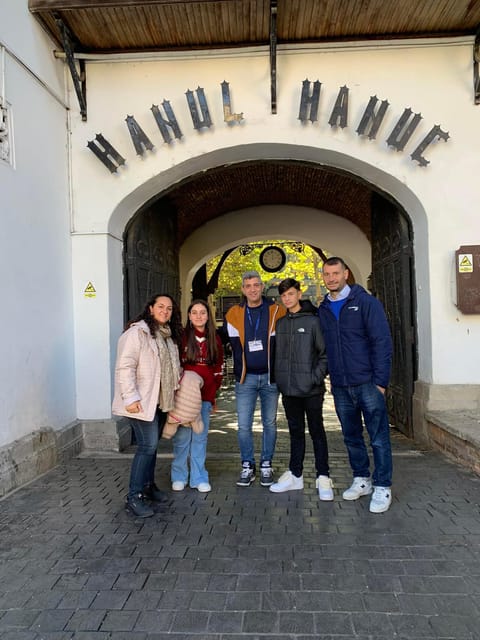
You begin at Strada Stavropoleos 5, in front of Caru’ cu Bere. The guide waits there with professional identification, so the meeting point is clear. Enter the address into your navigation app rather than relying on a vague search for the restaurant.
The private format matters here. Bucharest rewards questions, especially questions about why one building looks French, another Byzantine, and another distinctly communist. With only your own group, you can pause for photographs, ask for more detail, or move along when a stop has answered your curiosity.
The tour is conducted in Italian. That is the key reason to choose it. A good explanation of Romania’s political and cultural changes is much easier to follow in your strongest language, particularly when the subject moves from medieval rulers to the dictatorship of Nicolae Ceaușescu and the 1989 revolution.
More Bucharest walking tours:
- Bucharest: City Highlights Guided Walking Tour
★ 4.9 · 1,482 reviews - Bucharest Highlights Walking Tour
★ 5.0 · 469 reviews - Bucharest: Ghost Stories & Romanian Mythology Walking Tour
★ 4.9 · 287 reviews
Caru’ cu Bere and the first taste of old Bucharest
Caru’ cu Bere is both the meeting point and an early stop. The restaurant is one of Bucharest’s best-known historic dining places, and the guide gives you about ten minutes of explanation.
You should not expect a full meal as part of the tour. Food and drinks are not included, and the visit is a guided look rather than a dining reservation. Still, the building helps set the tone. Bucharest’s old center is not just a collection of monuments. Restaurants, shops, churches, banks, and nightlife all occupy the same compact district.
This is a practical first stop because it gives you a landmark that is easy to recognize at the end of the walk. If you want to return later for a meal, you already know where it is. Personal expenses remain your responsibility, so budget separately for anything you order.
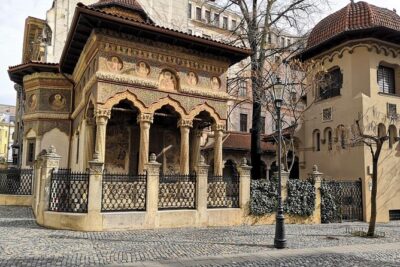
Stavropoleos Monastery and the city’s quieter side
The visit to Stavropoleos Monastery lasts about 15 minutes. This is one of the most appealing stops for anyone who wants more than façades and street photographs.
The monastery offers a calmer contrast to the nearby nightlife streets. Your guide can explain the church’s place in Romanian Orthodox culture and point out details that are easy to miss when you pass by alone. The setting also shows how small religious buildings can preserve a sense of stillness inside a busy capital.
I would pay close attention here, even if you are not especially interested in church architecture. The stop helps explain Bucharest’s older identity before the boulevards, royal buildings, and political monuments take over the route.
Modest clothing and respectful behavior are sensible when visiting a religious site. The supplied details do not specify a dress code or whether photography is always allowed, so follow the guide’s instructions inside.
Manuc’s Inn and the old commercial quarter
Next comes Manuc’s Inn, with about 15 minutes of guiding. The inn is an important reminder that Bucharest grew as a place of trade and movement, not only as a political capital.
The stop adds useful context to the Old Town. You are seeing more than a nightlife district with attractive streets. Buildings such as Manuc’s Inn connect the area to merchants, travelers, and the practical business of moving goods through the region.
This is also where the tour’s conversational approach can pay off. Ask your guide how the old quarter changed over time, and how its present-day restaurants and bars fit into the older fabric. The exact balance between architecture, history, and anecdotes will depend on your group and pace.
Same city, a completely different sort of day:
- Bucharest: Dracula’s Castle, Peles Castle, & Brasov Old Town
★ 4.5 · 17,858 reviews - Bucharest: Dracula Castle, Peles Castle & Brasov Old Town
★ 4.6 · 10,891 reviews - Bucharest: Dracula’s Castle, Peleș Castle & Brașov Day Trip
★ 4.5 · 5,919 reviews - Bucharest: Palace of Parliament Tickets and Guide
★ 4.3 · 3,182 reviews
Saint George, Cărturești Carusel, and Lipscani Street
The New Saint George Church receives a 15-minute visit. Like Stavropoleos, it gives you a chance to see Bucharest’s religious architecture up close rather than viewing it from the pavement.
The route then shifts to Cărturești Carusel, where you have a ten-minute photo stop. This bookstore is a popular visual highlight, with an elegant interior that makes a strong contrast with the rougher and more irregular streets around it. The stop is brief, so treat it as a chance to take in the design and make a few photographs, not as time for a long browse.
Old Town follows, with about ten minutes of guiding. Lipscani Street is the best-known part of this district and is closely tied to Bucharest’s nightlife. During the day, you can focus more easily on the buildings and street plan. Later, the same area becomes more social and energetic.
I like this sequence because it keeps the Old Town from feeling like one continuous restaurant strip. You see worship, commerce, books, old streets, and dining culture in quick succession.
The National Bank and Villacrosse Passage
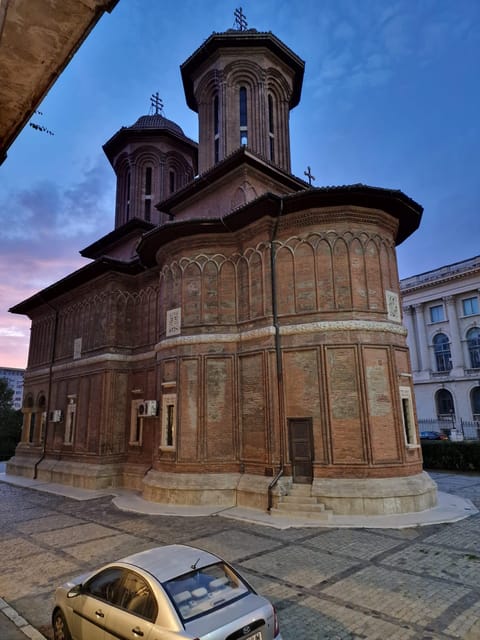
The National Bank of Romania receives another ten-minute explanation. Its presence adds a financial and institutional note to the walk. The building helps show how Bucharest’s central district was shaped not only by churches and private homes but also by national institutions.
Pasajul Villacrosse follows, also with roughly ten minutes of guiding. This covered passage has a different mood from the broad avenues and open squares. It is one of those places where the city’s architectural variety becomes clear in a small space.
These stops are especially useful if you enjoy details rather than only famous landmarks. You can ask about the buildings’ functions, decorative styles, and place in the city. Because the group is private, you do not have to wait for a large crowd to move or compete for the guide’s attention.
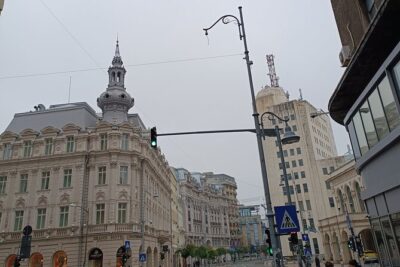
Calea Victoriei, Bucharest’s grand boulevard
From the Old Town, the walk continues along Calea Victoriei for about 15 minutes. This is described as Bucharest’s most elegant boulevard, lined with historic buildings, fashion shops, and refined cafés.
Calea Victoriei changes the pace of the tour. The Old Town feels compact and layered, while this avenue gives you a broader sense of Bucharest as a capital shaped by royal ambition, public institutions, and city life. Look up as you walk. The most useful part of the guide’s commentary may be above street level, where decorative façades and historic details are easy to miss.
The route also includes the Umbrellas Street as a ten-minute photo stop. It is a lighter moment after the institutional buildings and political history. You can take photographs, enjoy the visual change, and keep moving without turning the stop into a long detour.
The central walking route means no time is spent boarding transport between districts. That is efficient, but it also means you need to be ready for continuous walking. Comfortable shoes are not a minor suggestion here.
Revolution Square and the end of dictatorship
The most important political section comes at Revolution Square, where the guide spends about 20 minutes. The square is linked to the end of Ceaușescu’s dictatorship in December 1989.
This stop gives the tour emotional weight. You are not only looking at handsome buildings. You are standing in a place tied to a major break in Romania’s modern history. The guide can help connect the square’s buildings with the events that changed the country.
The surrounding architecture also matters. The square brings together different periods of Romanian life, and the route points out landmarks such as the Royal Palace and the National Library. The result is a useful lesson in how political power, monarchy, communism, and the post-1989 city can occupy one urban setting.
I would save questions for this section. If you want to understand what happened in December 1989, how the public space was used, or how Bucharest remembers that moment, this is the place to ask. The guide’s personal style may shape how much time goes into political explanation and how much goes into architecture.
The Romanian Athenaeum and the walk back
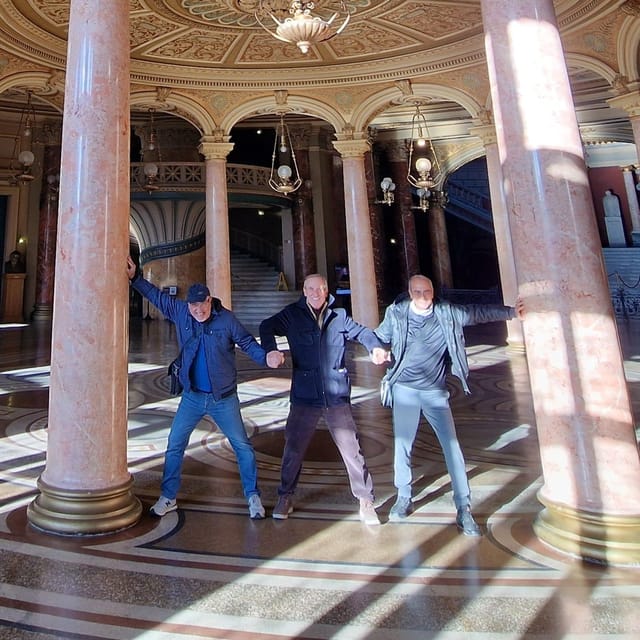
The final major stop is the Romanian Athenaeum, with about 15 minutes of guiding. Its presence gives the tour a fitting cultural finish after the commercial Old Town and politically charged Revolution Square.
The Athenaeum helps round out your view of Bucharest. You have seen religious buildings, trade spaces, government and financial institutions, royal landmarks, and a major cultural building. That range is more useful than a tour focused only on one historic quarter.
The tour then returns to Strada Stavropoleos 5. Ending where you began is convenient. You can continue exploring the Old Town, return to Caru’ cu Bere, or use the central location as a base for the next part of your day.
The schedule assigns specific times to each stop, but a private tour offers some room to adjust. The total duration is 2.5 hours, so flexibility does not mean unlimited time. If one place captures your interest, the guide can adapt the emphasis, but you will not be able to explore every site at length.
What the guide adds in Italian
The strongest reason to book this experience is the guide, not simply the route. The names connected with it include Giuseppe, often called Beppe, and Filippo Di Cataldo. The information identifies the guide as certified and Italian-speaking.
The comments associated with the experience place particular emphasis on clear explanations, passion, and the ability to connect facts with wider ideas. One account highlights learning to look under the surface, which is exactly the right approach for Bucharest. The city is easy to misread if you judge it only by its grand buildings or its worn façades.
Another account describes a full day of rain in which Giuseppe kept the tour engaging and comfortable. That suggests a guide willing to adapt, though you should still dress for the weather. No tour can make wet pavement pleasant for two and a half hours.
The Italian language also makes a difference in tone. You can ask questions naturally, follow complex political explanations, and enjoy anecdotes without stopping to translate every sentence in your head.
Is $53 per person a fair price?
At $53 per person, this is not the cheapest way to see Bucharest. It can still be good value if you want a private guide in Italian and prefer a carefully connected central route.
You are paying for three things: the guide’s time, the private format, and the ability to shape the walk around your group. A large group tour may cost less, but it usually offers less room for questions and a fixed pace. A self-guided walk costs almost nothing, but you would need to research the buildings and piece together the city’s political story yourself.
The value improves for couples, families, or small groups who would otherwise book several separate activities. It is less compelling if you only want photographs, dislike guided commentary, or already know Bucharest well.
Food, drinks, and personal expenses are not included. Plan for those separately, and remember that the tour does not provide a meal despite visiting Caru’ cu Bere.
Who should book this walk?
I would recommend it most strongly to Italian-speaking visitors seeing Bucharest for the first time. It is also a good choice if you want an introduction before exploring museums or returning to the Old Town on your own.
The tour suits people who enjoy architecture, political history, religious sites, and city stories in equal measure. It is not aimed at travelers who want a relaxed café crawl or a long visit inside each attraction.
The route is private and wheelchair accessible according to the activity details, but it is also marked as unsuitable for people with mobility impairments. That conflict deserves a direct question before payment. The walk includes historic streets, several stops, and a total of 2.5 hours on foot.
Cancellation is free up to 24 hours before the start, and you can reserve now and pay later. Those terms are useful if your schedule is still shifting, but they do not remove the need to check mobility arrangements or starting times.
Should you book it?
Book this tour if you want Bucharest explained in Italian by a guide who can connect churches, banks, royal buildings, cafés, and the 1989 revolution into one clear story. Giuseppe, Beppe, and Filippo Di Cataldo are the guide names associated with the experience, and the strongest praise focuses on passion, detail, and thoughtful commentary.
Skip it if you prefer to wander alone, want long interior visits, or need a tour built specifically around limited mobility without further confirmation. For everyone else, $53 buys a useful first look at central Bucharest, with enough flexibility to make the walk feel personal rather than mechanical.
FAQ
How long does the Bucharest Italian walking tour last?
The tour lasts 2.5 hours.
What language is the tour conducted in?
The live tour guide speaks Italian.
Is this a private tour?
Yes. It is a private and exclusive tour for your group.
Where does the tour start?
The meeting point is in front of Caru’ cu Bere at Strada Stavropoleos 5, 030081, Bucharest.
How will I recognize the guide?
The guide will be waiting in front of Caru’ cu Bere and will have a professional identification card.
What places are included?
The route includes Caru’ cu Bere, Stavropoleos Monastery, Manuc’s Inn, the New Saint George Church, Cărturești Carusel, Bucharest Old Town, the National Bank of Romania, Pasajul Villacrosse, Calea Victoriei, the Umbrellas Street, Revolution Square, and the Romanian Athenaeum.
Are food and drinks included?
No. Food, beverages, and personal expenses are not included.
What should I bring?
Bring comfortable shoes. The experience is a walking tour with several stops.
Can I cancel for a full refund?
Yes. You can cancel up to 24 hours in advance for a full refund.
Is the tour wheelchair accessible?
The activity details mark it as wheelchair accessible but also say it is not suitable for people with mobility impairments. Because those details conflict, contact the provider before booking to confirm whether the route meets your needs.
Newest Bucharest trips we have written up
- Bucharest: Dealu Mare Winery Private Trip with Wine Tasting★ 4.9 · 6 reviews
- Winery touring & private wine tasting – one day private tour★ 5.0 · 3 reviews
- Traditions in Bucharest: Village Museum and Wine Tasting★ 5.0 · 8 reviews
- Your rendez-vous with Europe’s past: time-travel to Maramures, Transylvania★ 5.0 · 6 reviews
- Village Museum Bucharest Guided Tour★ 5.0 · 6 reviews
- Private Wine Tasting at Bucharest’s First Wine Bar★ 5.0 · 3 reviews
- Walking Tour of Bucharest City Center – Private Tour★ 5.0 · 4 reviews
- Wine tasting in Bucharest Old town – bonus cheese platter★ 4.5 · 6 reviews
Bucharest Walking Tours, compared.
Ghost Stories & Romanian Mythology Walking Tour
Read our review →
Walking Tour- Delightful Bucharest (Highlights, Stories, Sights)
Read our review →
4h Bucharest Private Tour (2h by Car and 2h Walking in Old Town)
Read our review →
Browse the lists this tour appears in