
Reviewed · BUCHAREST WALKING TOURS
Bucharest: City Highlights Guided Walking Tour
Bucharest’s story changes block by block: medieval court, royal boulevard, communist power center, and the 1989 Revolution all fit into this two-hour walk. The tour begins near the city’s 0-kilometer point and ends in front of the massive Palace of Parliament, giving you a quick but useful map of central Bucharest.
I like the route’s clear historical arc, especially the shift from the Old Princely Court to Revolution Square and then the communist Civic Center. I also like that guide Claudiu adjusts the walk to your interests and has been praised for answering questions about both Romanian history and his own life in the country.
The main drawback is time. You cover about 3.5 kilometers, or 4,600 steps, in two hours, so most sights are viewed from outside. At $45 per person, this is not the cheapest short walk, and the Palace of Parliament interior is an extra arrangement rather than part of the standard tour.
Key points to know before you book
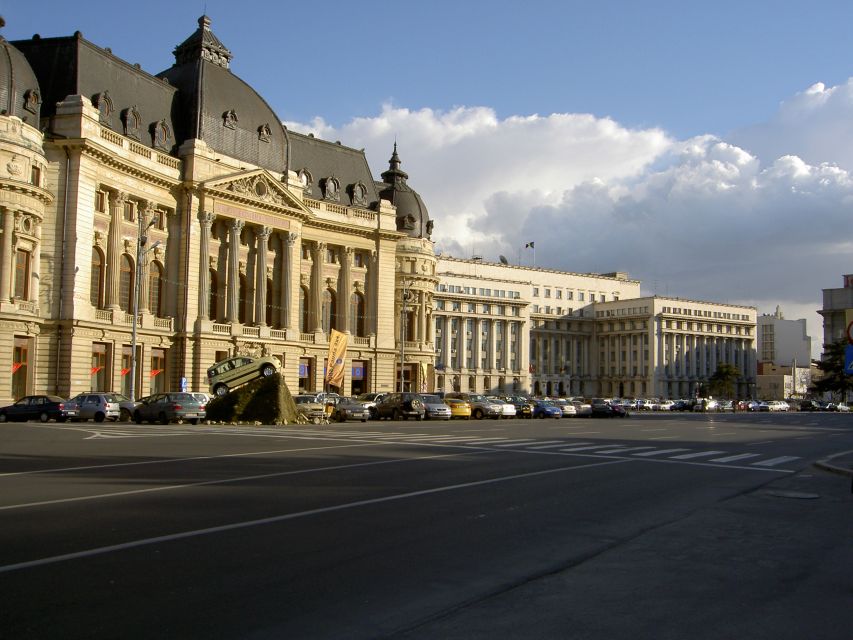
- See four different Bucharests in one walk: medieval old town, royal-era Calea Victoriei, the 1989 Revolution sites, and the communist Civic Center.
- Start beside the She-wolf statue: The meeting point is in Roma Square, on Lipscani Street, close to Bucharest’s marked 0-kilometer point.
- Expect about 3.5 kilometers of walking: The route involves roughly 4,600 steps and is not suited to wheelchair users or people with mobility limits.
- Guide Claudiu shapes the discussion: He has been praised for building the walk around visitors’ interests and explaining Romanian life as well as city history.
- The Palace of Parliament is the finish, not an included indoor visit: Interior entry may be arranged before or after the walk, but you must request it when booking and availability is not guaranteed.
- Bring identification, not luggage: You need a passport or ID card, and large bags are not allowed.
Starting at Bucharest’s 0-kilometer point
Your meeting point is next to the Statue of the She-wolf in Roma Square, on Lipscani Street. This is a handy place to begin because you are already close to the old town, and the nearby 0-kilometer marker gives the walk a simple geographic starting point.
The statue recalls the Roman story of Romulus and Remus being raised by a she-wolf, a symbol that links Romania to its Latin roots. You do not need to know the story in advance. The useful part is that Claudiu can place Bucharest on a larger historical map before the walk begins.
From here, you move into the old town. Keep in mind that this is a walking tour through a central city district, not a vehicle tour with long pauses at every sight. The route works best if you enjoy listening while walking and are comfortable keeping a steady pace.
More Bucharest walking tours:
- Bucharest: City Highlights Guided Walking Tour
★ 4.9 · 1,482 reviews - Bucharest Highlights Walking Tour
★ 5.0 · 469 reviews - Bucharest: Ghost Stories & Romanian Mythology Walking Tour
★ 4.9 · 287 reviews
Old Princely Court and the medieval center
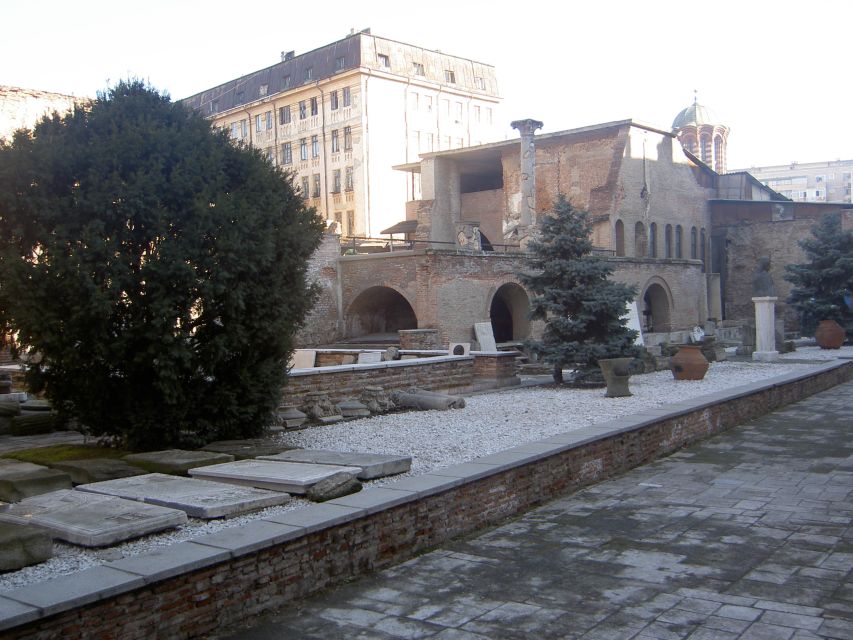
The Old Princely Court and Church provide the first major stop. This is where the walk moves beyond broad national history and gives you a connection to Bucharest’s earlier political life.
The court was tied to the rulers of Wallachia, including Vlad the Impaler, the historical figure often linked to the Dracula legend. The church adds a more intimate sense of the period. Together, the remains and the religious building help explain why this part of the city matters, even when the surrounding streets feel modern and commercial.
I like this early stop because it prevents Bucharest from being reduced to its 20th-century past. Many first-time visitors associate the city mainly with communist buildings and the Palace of Parliament. The Old Princely Court makes clear that Bucharest had a much longer story before the grand boulevards and concrete government districts appeared.
This part of the walk also shows why a guide helps. Ruins and older churches can be easy to pass without context. Claudiu’s role is to explain what you are seeing and connect the site to the city’s later development.
Royal Bucharest around the former palace square
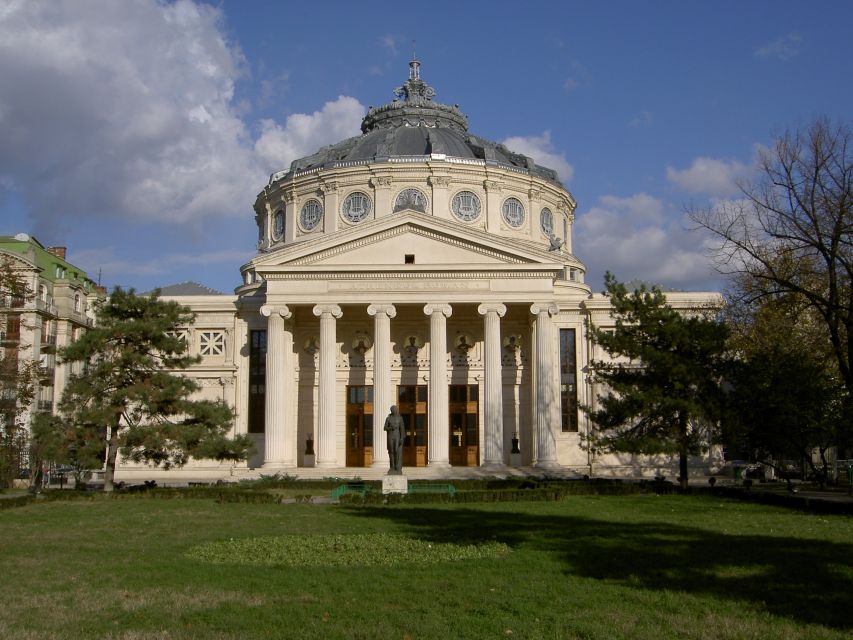
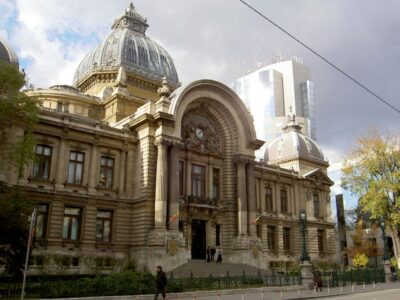
The route then heads toward the former Square of the Palace, where the former Royal Palace and the Romanian Athenaeum come into view. This is a major change of mood from the narrow old-town streets.
The area reflects the period when Bucharest was being shaped as a European capital. The Royal Palace points to Romania’s monarchy, while the Athenaeum is one of the city’s best-known cultural buildings. The walk does not treat the city as a single architectural style. Instead, you see how different governments and social periods left their mark within a fairly compact area.
The Athenaeum is especially worth a pause, even if you only see it from outside. Its role in Romanian cultural life gives the building more meaning than a quick photograph can convey. The former Royal Palace also helps you understand how power was displayed before the communist regime replaced royal symbolism with a different kind of monumentality.
You may find the pace here more relaxed than in the old town because the buildings need time to absorb. Still, the tour lasts only two hours, so do not expect a long interior visit at each stop. The experience is designed to give you orientation and context, not to replace a museum afternoon.
Revolution Square and the events of 1989
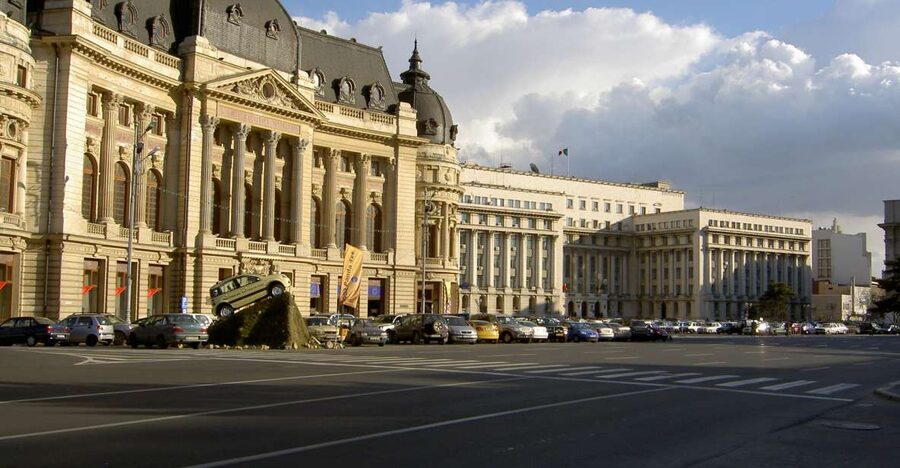
The former Communist Party headquarters and today’s Revolution Square form the emotional center of the walk. This is where the tour turns from architecture toward living political memory.
Revolution Square was a key setting during the 1989 uprising that ended Nicolae Ceaușescu’s communist rule. The former party headquarters is more than another imposing building. It was a place from which the communist state directed the country, and its connection to the revolution makes the surrounding square one of the most important places in modern Romanian history.
This is a good point to ask questions. A short city walk cannot explain every part of communist Romania, but it can give you the basic structure: the concentration of political power, public resistance, and the sudden break in 1989. Claudiu has been praised for being willing to discuss Romania as a lived country rather than treating the past as a list of dates.
I value this section because it avoids a common problem with city sightseeing. Buildings can look grand, severe, or attractive, but their meaning changes when you know what happened in front of them. Revolution Square is a place where the political story is tied directly to the streets under your feet.
More Bucharest city tours:
- Bucharest: 2-Hour City Highlights Bike Tour
★ 4.8 · 269 reviews - Bucharest Tuk Tuk city tour
★ 5.0 · 188 reviews - Bucharest Tuk Tuk City Tour
★ 4.9 · 167 reviews - Bucharest Panoramic Sightseeing – Private City Tour
★ 5.0 · 128 reviews
Calea Victoriei and the Little Paris idea
From Revolution Square, the route follows Calea Victoriei, Bucharest’s most historic boulevard. This is the section that explains the city’s old nickname, the Little Paris of the East.
The name points to Bucharest’s 19th and early 20th-century ambition to look and feel like a modern European capital. Along Calea Victoriei, you see built heritage from that period, with a mix of grand facades and later changes. The important point is not that Bucharest copies Paris perfectly. It is that the boulevard shows the city reaching outward, adopting European styles, and creating a public face suited to a growing capital.
Calea Victoriei is also where the city’s architectural layers become easiest to compare. The route has already shown you medieval religious buildings and royal institutions. Now you walk through the period of modernization before the communist government imposed its own plans on the center.
I would pay close attention to the spaces between the headline sights. A guided walk can help you notice details you would otherwise miss, such as how one building’s style differs from the next or how the boulevard connects royal, cultural, and commercial parts of the city.
Stavropoleos Church and a pause in the old town
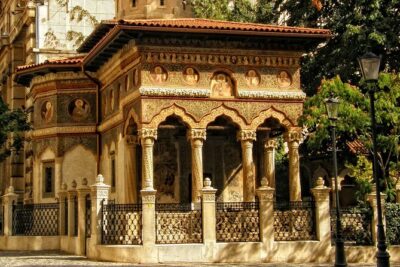
The tour includes a short stop at Stavropoleos Church, near the History Museum. This small church offers a sharp contrast to the larger public buildings on Calea Victoriei and at Revolution Square.
Its scale is part of the appeal. After the broad boulevard and political buildings, Stavropoleos brings you back to a more personal side of Bucharest. The church is linked to the city’s older religious and architectural traditions, and its setting makes it a useful reminder that the capital was not built only through royal projects and state power.
The stop is short, so plan your expectations accordingly. You may not have time for an extended visit or a quiet period inside. Its value on this tour is as part of the larger sequence: old town, royal city, communist power, then a return to an older religious layer before crossing the Dambovita River.
The nearby History Museum also helps place this stop within the city center, although entry to museums is not part of the tour. If you want longer indoor visits, treat this walking experience as a first look and return later on your own.
Crossing the Dambovita into the Civic Center
After Stavropoleos Church, you cross the Dambovita River and enter the Civic Center, the new central district created during the communist era. This is the route’s biggest visual change.
The Civic Center was built through a vast redevelopment project that reshaped the city. Its broad spaces and monumental buildings were designed to show state power on a huge scale. Compared with the close streets of the old town and the more decorative character of Calea Victoriei, this area feels more formal and open.
For me, this section gives the Palace of Parliament a necessary setting. Seen by itself, the building can seem like an enormous curiosity. Seen as part of the Civic Center, it becomes easier to understand as the centerpiece of a much larger urban plan.
The walk also lets you compare two types of city planning. Earlier Bucharest developed through layers of churches, palaces, boulevards, and civic buildings. The communist Civic Center imposed a more unified vision over a large area. That contrast is one of the tour’s strongest teaching points.
The open spaces can also make the walk feel longer, especially if the weather is poor. The total distance is not extreme for a fit person, but this is not a stop-and-go sightseeing route with much sitting. Wear comfortable shoes and bring water if needed.
Finishing at the Palace of Parliament
The walk ends at Constitution Square, in front of the Palace of Parliament. This gives the tour a strong final image and ties together the communist section of the route.
The Palace of Parliament is famous for its huge scale, but size alone does not explain why it matters. Its construction was part of Ceaușescu’s plan to remake central Bucharest around the communist state. The building represents money, labor, political control, and an urban vision that changed the city permanently.
The square in front of it gives you room to take in the relationship between the building and the Civic Center. After walking through tighter streets, the broad space makes the final stop feel deliberately monumental.
Indoor entry is not included in the $45 price. You may ask for a Palace of Parliament visit before or after the walk, but it must be requested at booking and depends on availability at that time. This detail matters because you should not assume that arriving at the end of the walk guarantees an interior visit.
If seeing the inside is important to you, make that request early. If it is not available, the outdoor portion still gives you the building’s place in Bucharest’s political and urban story, but it will not provide the same detail as a formal interior tour.
What $45 buys you in two hours
At $45 per person, this tour sits above the price of a casual group walk. The value depends on what you want from a short city introduction.
You are paying for an English-speaking guide, a carefully connected route, and historical explanation across several periods. The tour does not spend long inside paid attractions, and entry fees are not included. If you want a low-cost orientation and plan to explore museums on your own, the price may feel high.
I think the cost makes more sense if you are new to Bucharest and want to understand how the main districts fit together quickly. You get the old town, monarchy, Calea Victoriei, the 1989 Revolution, the Dambovita crossing, and the communist Civic Center in one route. Recreating that sequence alone would take research and a good map.
The strongest added value is Claudiu’s flexible approach. He has been praised for asking about interests, shaping the walk around architecture and history, and answering questions about his life in Romania. One visitor also found that he opened the way into a couple of buildings that seemed closed to the public, though you should not treat that as a guaranteed part of every departure.
The experience has received three verified ratings of five out of five. That is a very small sample, so I would not use it as proof that every departure will be identical. Still, the repeated praise for clear explanations and personal attention points to the tour’s main strength.
Pace, access, and what to bring
The stated distance is about 3.5 kilometers, or 2.3 miles, and roughly 4,600 steps. That sounds modest, but the route includes continuous walking, standing at stops, and city streets that may not be easy for every visitor.
The tour is not suitable for wheelchair users, people with mobility impairments, or people with a low level of fitness. If you need frequent seated breaks or a fully step-free route, choose another way to see central Bucharest.
Bring a passport or ID card. Large bags and luggage are not allowed, so leave bulky belongings at your accommodation or use an appropriate storage option before arriving. Comfortable shoes matter more than dressy clothing here.
The guide speaks English. Free cancellation is available up to 24 hours before the start, and you can reserve while paying later, which helps if your Bucharest plans are still shifting.
Who should book this Bucharest walk?
I would choose this tour for a first visit, especially if you want the city’s main historical themes explained in plain language. It suits people who prefer walking to a bus route and who like seeing how architecture reflects political change.
It is also a good fit if you are curious about communist Romania but do not want a tour focused only on Ceaușescu and the Palace of Parliament. The route gives that subject its proper place while also covering medieval, royal, religious, and cultural Bucharest.
You may want something else if you prefer long museum visits, a slow photography walk, or a tour with transportation. Two hours is enough for a strong overview, not enough for deep exploration of every building.
Should you book it?
Book this walk if you want a compact introduction to Bucharest with a guide who can connect buildings to the people and politics behind them. The route is especially useful because it ends with the Palace of Parliament only after showing you the older city that the communist Civic Center replaced in part.
Skip it if $45 feels too high for an outdoor overview or if you need a fully accessible route. Also, request the Palace of Parliament interior visit when booking if that is central to your plans. For a fit visitor with two free hours, comfortable shoes, and an interest in Romanian history, this is a focused way to get your bearings without reducing Bucharest to one enormous government building.
FAQ
Where does the Bucharest walking tour begin?
The guide meets you next to the Statue of the She-wolf in Roma Square, on Lipscani Street, near Bucharest’s 0-kilometer point.
Where does the tour finish?
The walk finishes at Constitution Square, in front of the Palace of Parliament, at Piața Constituției 5 in Bucharest.
How long is the tour?
The guided walk lasts two hours and covers about 3.5 kilometers, or 2.3 miles, with roughly 4,600 steps.
Is entry to the Palace of Parliament included?
No. An interior visit may be arranged before or after the walk, but you must request it when booking and availability is not guaranteed.
What language is the tour offered in?
The live guided tour is offered in English.
What should I bring, and are large bags allowed?
Bring a passport or ID card. Luggage and large bags are not allowed on the tour.
Newest Bucharest trips we have written up
- Bucharest: Dealu Mare Winery Private Trip with Wine Tasting★ 4.9 · 6 reviews
- Winery touring & private wine tasting – one day private tour★ 5.0 · 3 reviews
- Traditions in Bucharest: Village Museum and Wine Tasting★ 5.0 · 8 reviews
- Your rendez-vous with Europe’s past: time-travel to Maramures, Transylvania★ 5.0 · 6 reviews
- Village Museum Bucharest Guided Tour★ 5.0 · 6 reviews
- Private Wine Tasting at Bucharest’s First Wine Bar★ 5.0 · 3 reviews
- Walking Tour of Bucharest City Center – Private Tour★ 5.0 · 4 reviews
- Wine tasting in Bucharest Old town – bonus cheese platter★ 4.5 · 6 reviews
Bucharest Walking Tours, compared.
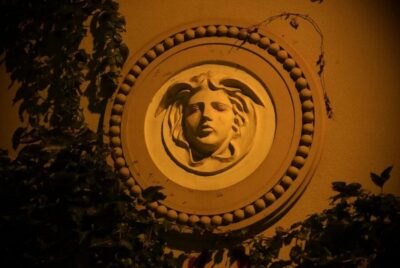
Ghost Stories & Romanian Mythology Walking Tour
Read our review →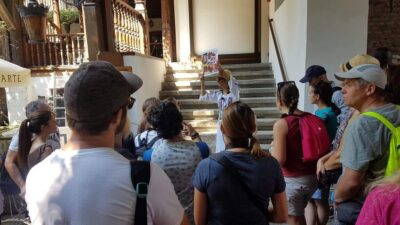
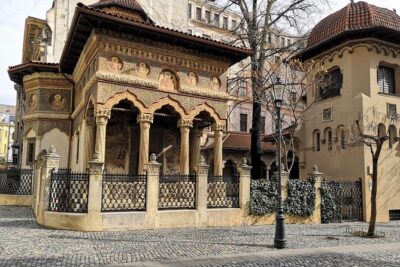
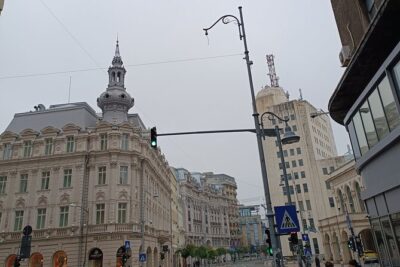
Walking Tour- Delightful Bucharest (Highlights, Stories, Sights)
Read our review →
4h Bucharest Private Tour (2h by Car and 2h Walking in Old Town)
Read our review →
Browse the lists this tour appears in