
Reviewed · BUCHAREST COMMUNISM AND CEAUSESCU TOURS
Bucharest: Relics of Communism 3-Hour Walking Tour
Bucharest’s communist past is easiest to understand when you connect the grand buildings with ordinary life. This three-hour walk takes you from the balcony of Ceausescu’s last speech to the enormous Palace of the Parliament, while filling in the human story: ration cards, black-market shopping, propaganda, secret police, and the shock of 1989.
I like the small groups of up to 10 and the way the route mixes famous sights with easily missed places such as Michael the Voivode Church. I also like the guides’ personal approach. Elena, Stefan, and Tudor have been praised for clear explanations, photos, stories, and thoughtful answers. The main drawback is that this is an outdoor walking tour, so hot weather, rain, and uneven city pavements can affect your comfort.
Key points at a glance
- Start at Revolution Square: Hear how Ceausescu’s final speech turned into the beginning of the 1989 uprising.
- See communist power in physical form: The Palace of the Parliament and Civic Centre show the scale of Ceausescu’s building program.
- Visit a church spared from erasure: Michael the Voivode Church offers a quieter counterpoint to the regime’s grand avenues.
- Learn daily-life details: Ration cards, shortages, propaganda, the black market, and secret police duties make the era easier to grasp.
- Benefit from a small group: With no more than 10 people, you can ask questions and keep a conversational pace.
- Get useful context for later sightseeing: The walk can help you understand the Palace of the Parliament before an interior visit.
Why this communist-era walk matters in Bucharest
Bucharest can feel like several cities layered on top of one another. Elegant older buildings sit near concrete apartment blocks. Broad avenues lead toward vast government structures. A church may appear tucked behind later construction, while a memorial recalls a political system that ended within living memory.
This tour gives those contrasts a clear explanation. You are not simply looking at large buildings and being told when they were built. You are shown how architecture served power, how entire areas were reshaped, and how ordinary Romanians managed daily life under Nicolae Ceausescu.
That practical focus is one of the walk’s best features. You hear about ration cards, food shortages, the black market, official propaganda, and the secret police. These details turn an abstract lesson about communism into something you can picture at street level.
The tour also deals with the 1989 Revolution and Romania’s move toward democracy. The subject can be emotional, especially for people who remember the period or grew up hearing family stories. The guides are praised for presenting several sides of the past rather than reducing everything to a list of dates.
More communism and Ceausescu tours in Bucharest:
- The Real tour of Communism
★ 5.0 · 666 reviews - Life under Communism
★ 5.0 · 358 reviews - 3-Hour Guided Tour of Communist Bucharest
★ 4.9 · 303 reviews
Meeting the group at the Memorial of Rebirth
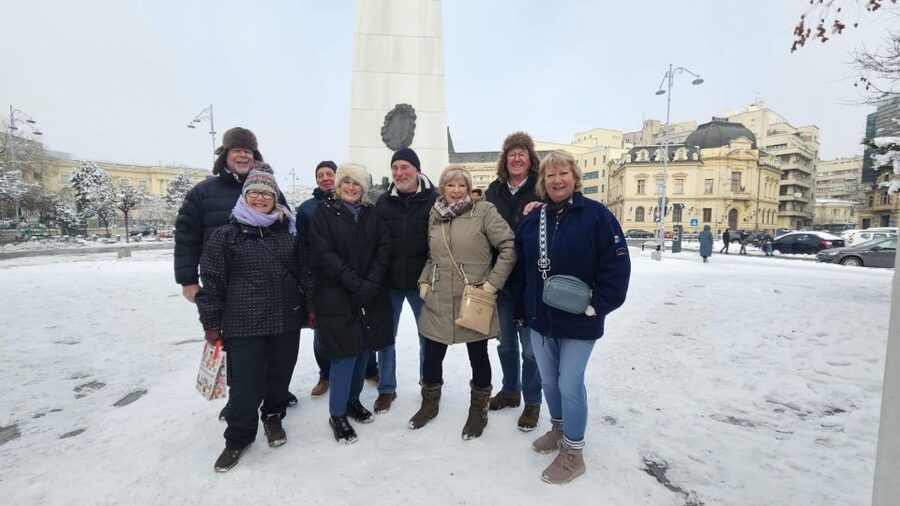
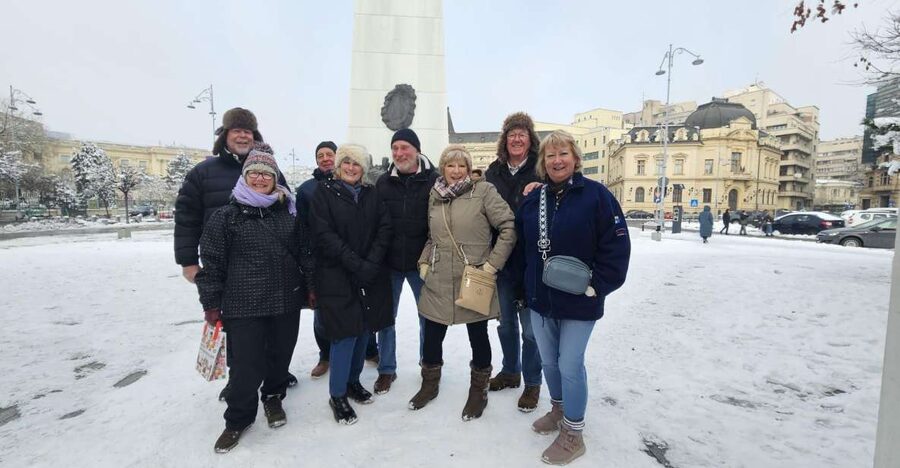
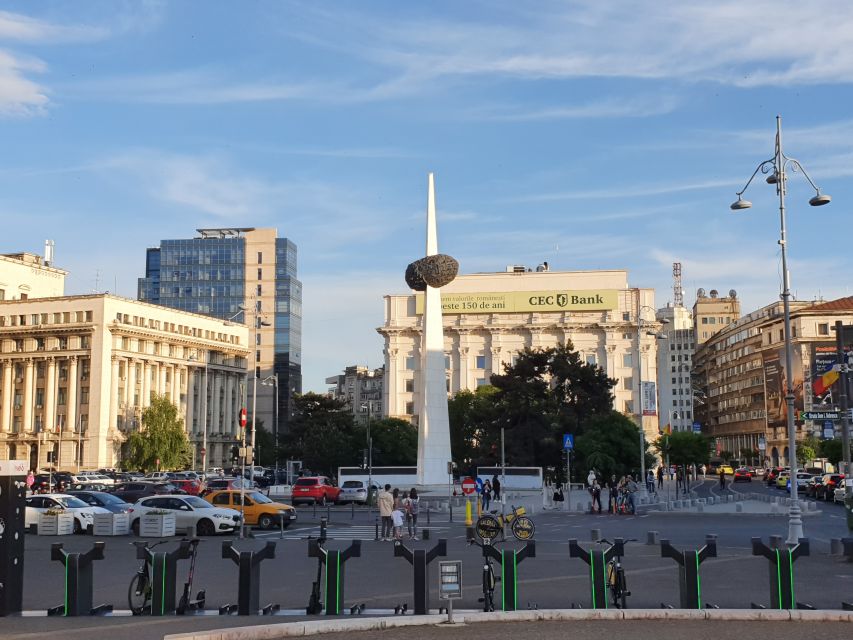
The tour begins at the Memorial of Rebirth in Revolution Square. This is a useful starting point because the square brings together the memory of the revolution, modern Romanian politics, and the remains of the old power structure.
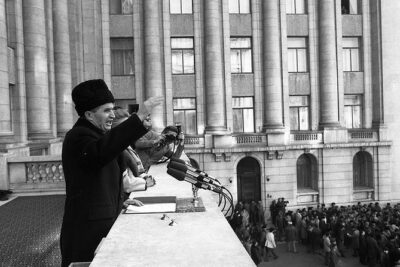
Your guide then leads you to the balcony connected with Ceausescu’s final public speech. This is the place where the tour’s political story becomes immediate. Ceausescu addressed the crowd expecting the familiar response, but the public mood shifted. What followed helped bring down his regime.
Plan to spend time listening here rather than rushing to take photos. The stop lasts about 20 minutes, giving your guide room to explain the sequence of events and Romania’s transition after 1989.
Guides such as Elena have used photographs and other visual material to make this section clearer. That is useful because the square has changed, and a modern visitor may not immediately understand how the space looked or felt during the uprising.
Piața 21 Decembrie 1989 and the human story
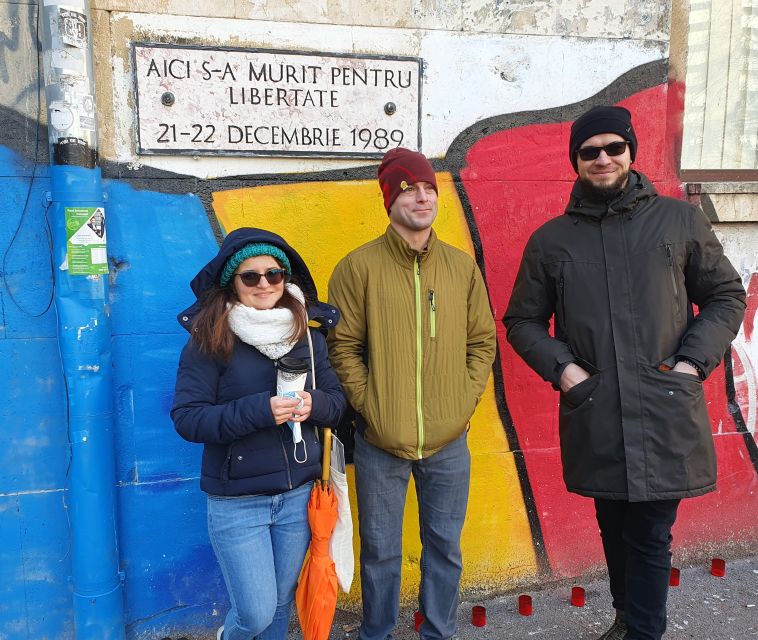
The next stop is Piața 21 Decembrie 1989, with about 15 minutes of guided discussion. The name itself points to the date associated with the revolution in Bucharest.
This part of the walk helps move the story beyond Ceausescu as an individual ruler. You learn how public spaces became places of protest, uncertainty, and danger. The emphasis is on what the political change meant for people in the city, not only on the official timeline.
I would ask questions here if you are interested in how Romania’s transition affected everyday life after communism. The small-group format makes that possible. Several guides have been praised for taking time with questions rather than delivering a fixed speech and moving on.
The tour is conducted in English. Past guides have included Elena, Stefan, and Tudor, and the exact guide depends on the date and availability.
Michael the Voivode Church and the buildings the regime wanted forgotten
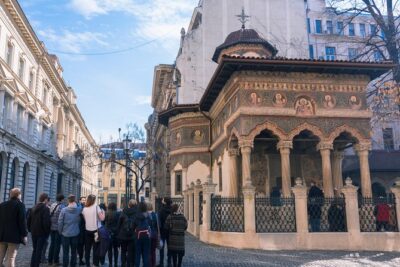
Michael the Voivode Church is one of the most interesting stops because it breaks up the monumental communist story. The visit lasts around 15 minutes and introduces the churches that communist planners wanted to push aside or erase from public attention.
This is where the walk’s theme becomes more visual. The regime’s new districts were designed to project order, scale, and state power. Older religious buildings represented a different set of traditions and loyalties. Seeing one of these churches in the middle of Bucharest gives you a useful sense of what was lost, moved, or threatened during the redevelopment of the city.
The stop is not presented as a grand interior tour. Instead, it works as a compact historical pause. You get a chance to consider the cost of replacing older city fabric with planned avenues and monumental structures.
For me, this is the kind of stop that justifies taking a guided walk rather than following a basic city map. A first-time visitor might pass the church without knowing why it matters.
More Bucharest walking tours:
- Bucharest: City Highlights Guided Walking Tour
★ 4.9 · 1,482 reviews - Bucharest Highlights Walking Tour
★ 5.0 · 469 reviews - Bucharest: Ghost Stories & Romanian Mythology Walking Tour
★ 4.9 · 287 reviews - Bucharest: Guided Walking Tour with Romanian Snack
★ 4.9 · 228 reviews
Piața Unirii and the contrast between old and new Bucharest
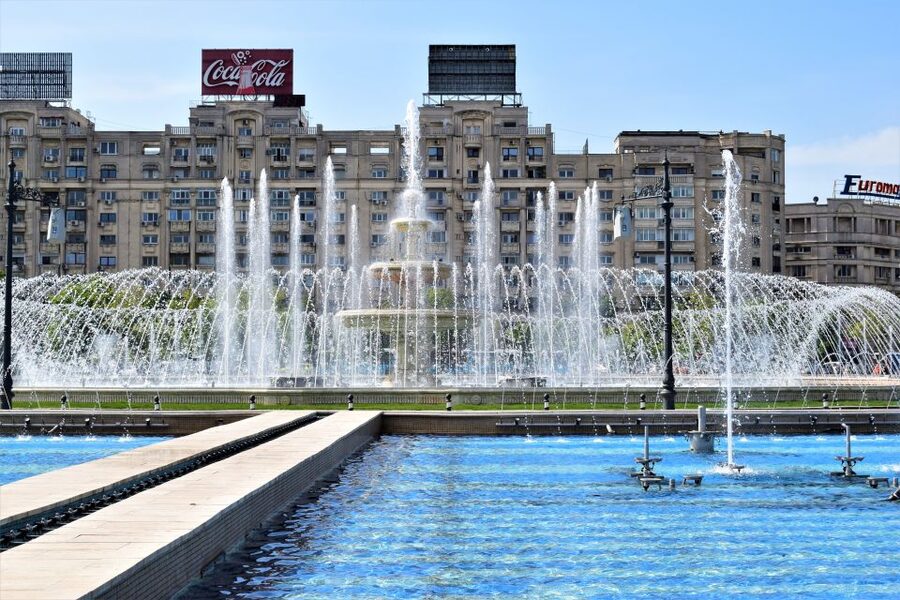
The walk continues to Piața Unirii for another 15-minute explanation. Here you can better see the contrast between Bucharest’s older architecture and the communist blocks and planned districts.
The value of this stop is comparison. Ceausescu’s urban projects were not built in an empty field. They altered an existing city, and the result is a mix of grand plans, older structures, concrete housing, and broad traffic routes.
Your guide explains how the Civic Centre project changed this part of Bucharest. You are encouraged to look at the city as a political document. The buildings tell you what the government wanted citizens and foreign visitors to see: order, control, scale, and the central role of the state.
At the same time, the walk keeps returning to ordinary people. The contrast between the official image of progress and the realities of shortages is central to understanding the period.
The Palace of the Parliament and Ceausescu’s Civic Centre
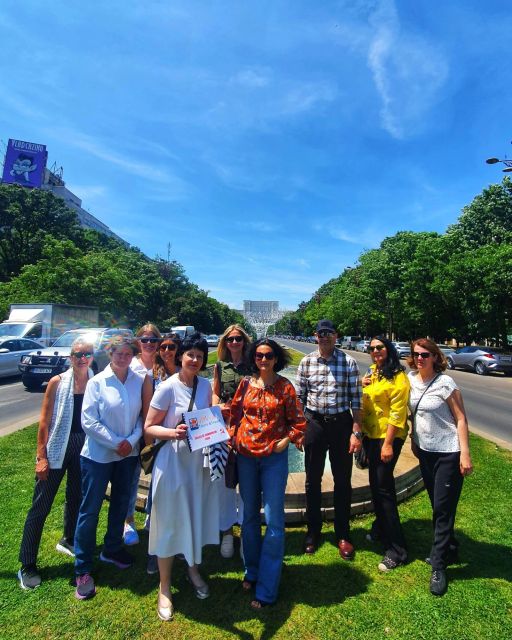
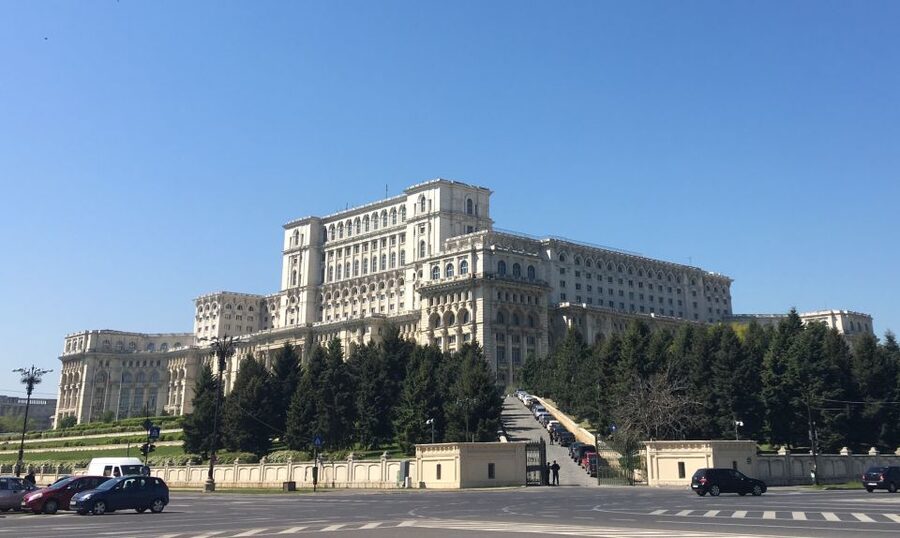
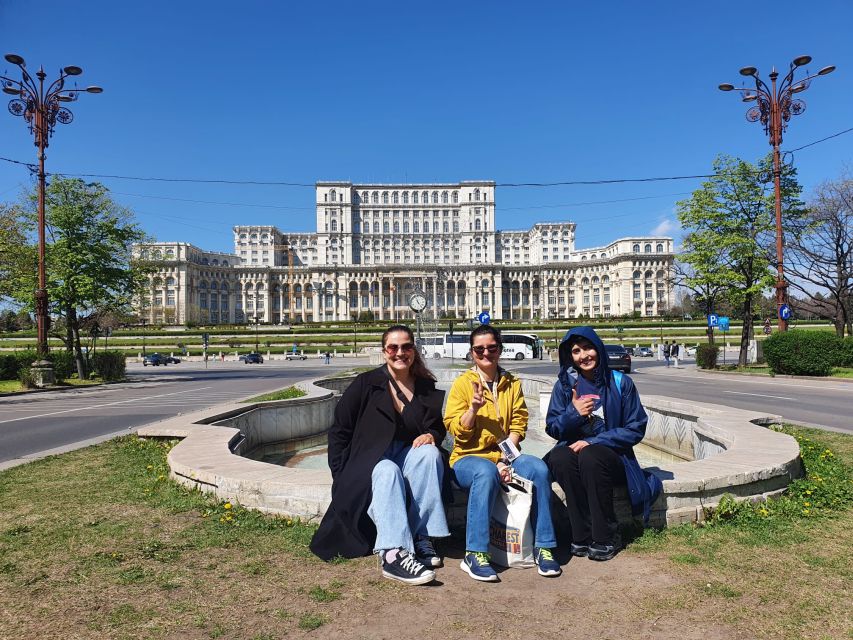
The Palace of the Parliament is the visual climax of the route. The tour allows about 20 minutes for guided discussion, and you finish at Piața Constituției, the square in front of the building.
The Palace was planned as the absolute center of power. Its scale is difficult to take in from street level, but the guide’s explanation helps you understand why it was built and what the project represented. It was not merely an administrative building. It formed part of a much larger plan to remake central Bucharest around Ceausescu’s authority.
The surrounding Civic Centre buildings matter just as much as the Palace itself. Look beyond the main structure and consider the planned avenues, blocks, and monumental arrangement. The project reshaped a large section of the city and left a permanent mark on Bucharest.
The exterior discussion is valuable even if you later book an interior visit. One past participant used the walk to better understand a subsequent Palace visit, including the view down the parade avenue from the balcony. If you want to go inside the Palace, treat that as a separate plan, since admission is not included in this walking tour.
The short stop also has a practical limitation. Twenty minutes is enough for context and photographs, but not for an exhaustive architectural visit. The tour is about the political meaning of the building and its place in the city, not a full interior examination.
What everyday life under Ceausescu looked like
The strongest part of this experience is the link between monumental architecture and domestic life. You hear about ration cards, limited supplies, black-market buying, propaganda, and the secret police.
These subjects help answer the question that large buildings alone cannot: what did the system feel like for people living under it?
A ration card is a small object, but it points to a wider system of control. Food shortages changed how people planned their days. The black market became part of the informal economy. Propaganda shaped the official story, while fear of the secret police affected what people said and to whom.
Guides have also used old schoolbooks, children’s mandatory scarves, photographs, and documentary images of the revolution to make this period easier to picture. These objects are useful because they bring the subject down to a personal scale.
The tour does not treat the communist years as a single, simple block. You get a look at the political system, its public image, the architecture it produced, and the way life felt behind that image. That balance is especially helpful if your prior knowledge is limited to Ceausescu’s name and the Palace of the Parliament.
Guide style and the value of a small group
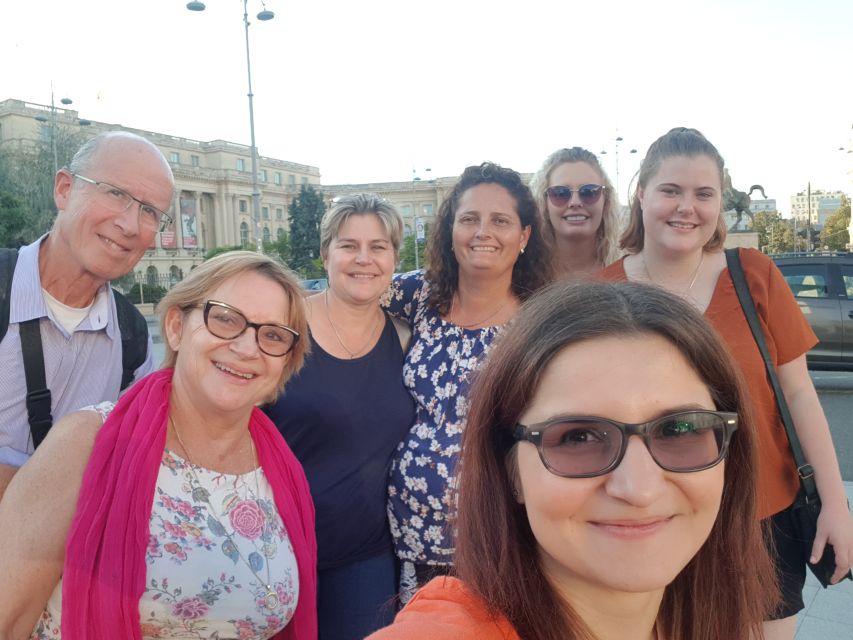
The quality of this walk depends heavily on the guide. Elena is repeatedly described as warm, prepared, and able to explain the subject in natural English. She has also been praised for offering extra details, answering questions, sharing reading suggestions, and helping people make sense of the period after the walk.
Stefan has been praised for keeping the history light and readable without losing important facts. Tudor has been noted for using photographs and taking extra time to answer questions. These comments point to a tour style that is conversational rather than strictly scripted.
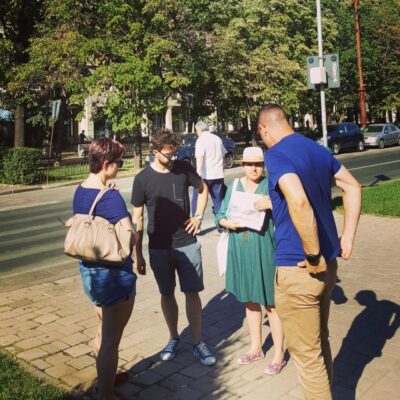
The group limit of 10 matters. Bucharest’s communist history raises questions that do not fit neatly into a standard speech. You may want to ask about family life, religion, the revolution, or the shift to democracy. A small group gives you a better chance to do that.
The pace is generally manageable. One person described the walk as leisurely, and several guides have allowed the tour to run longer when discussion continued. You should not count on an extension, but the format appears to leave room for questions instead of treating the schedule as a race.
Price, timing, and what you receive
The price is $44 per person for three hours. That is fair value if you want an informed explanation of Bucharest’s communist landmarks rather than a quick photo walk.
You are paying for an English-speaking guide, a small group, the historical interpretation at each stop, and a Romanian snack souvenir. Hotel pickup and drop-off are not included, so you need to reach the Memorial of Rebirth in Revolution Square on your own.
The route covers several central areas on foot and finishes at Piața Constituției. Wear comfortable shoes and bring water, especially in warm weather. You will spend time outside, and the tour has no vehicle transfer between stops.
The booking terms are also flexible. You can cancel up to 24 hours before the start for a full refund, and reserve now while paying later. Starting times vary, so check availability for your date.
Who will get the most from this tour
I would choose this walk if you want a clear introduction to Romania’s communist period and prefer stories tied to real places. It suits first-time visitors, people interested in 20th-century politics, architecture fans, and anyone planning to visit the Palace of the Parliament.
It is also a good choice for a short Bucharest stay. In three hours, you cover Revolution Square, Piața 21 Decembrie 1989, Michael the Voivode Church, Piața Unirii, the Palace, and the Civic Centre. You then have the rest of the day to explore independently.
It may be less suitable if you dislike serious political subjects or want a tour focused only on beautiful buildings. The walk deals with repression, shortages, fear, revolution, and forced urban change. It is informative, but parts may be moving.
You should also know that this is not a full Palace interior tour. If seeing the grand rooms inside is your main goal, make separate arrangements and use this walk for the context that the building itself cannot provide.
Should you book the Bucharest communist history walk?
Book it if you want Bucharest to make more sense. The Palace of the Parliament is impressive, but its scale means little without the story of the Civic Centre and the society that paid for it. Revolution Square is visually important, but the political events there become far clearer with a guide.
I especially recommend it for anyone who wants the everyday side of history: food shortages, ration cards, propaganda, religion, school life, and the black market. The small group and guides such as Elena, Stefan, and Tudor add room for questions and personal explanation.
Skip it only if you want a short sightseeing loop with little discussion, or if you already have a detailed understanding of Ceausescu’s Romania. For most visitors, $44 buys a useful three-hour framework for seeing Bucharest with sharper eyes.
FAQ
Where does the Bucharest communist history tour begin?
The tour begins at the Memorial of Rebirth in Revolution Square.
Where does the tour finish?
The walk finishes at Piața Constituției, near the Palace of the Parliament and the Civic Centre area.
How long does the tour last?
The scheduled duration is three hours.
Is the tour conducted in English?
Yes. The tour includes a live English-speaking guide.
Is entry inside the Palace of the Parliament included?
No interior admission is listed as included. The tour provides an outdoor guided visit and discussion of the Palace and Civic Centre.
What is included in the price?
The price includes the walking tour with an English guide and a Romanian snack souvenir. Hotel pickup and drop-off are not included.
Newest Bucharest trips we have written up
- Bucharest: Dealu Mare Winery Private Trip with Wine Tasting★ 4.9 · 6 reviews
- Winery touring & private wine tasting – one day private tour★ 5.0 · 3 reviews
- Traditions in Bucharest: Village Museum and Wine Tasting★ 5.0 · 8 reviews
- Your rendez-vous with Europe’s past: time-travel to Maramures, Transylvania★ 5.0 · 6 reviews
- Village Museum Bucharest Guided Tour★ 5.0 · 6 reviews
- Private Wine Tasting at Bucharest’s First Wine Bar★ 5.0 · 3 reviews
- Walking Tour of Bucharest City Center – Private Tour★ 5.0 · 4 reviews
- Wine tasting in Bucharest Old town – bonus cheese platter★ 4.5 · 6 reviews
Bucharest Communism and Ceausescu Tours, compared.
Bucharest Essential Tour: Old Town, Calea Victoriei & Communism
Read our review →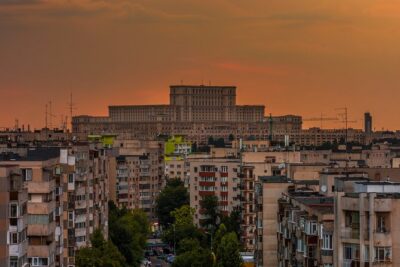

Museum of Communism Ticket with Communist Coffee
Read our review →
Dinner+Tour at Museum of Communism after closing
Read our review →Browse the lists this tour appears in